


The 1792 Silver Disme Is the Dime America Almost Forgot
In 1792, the United States did more than launch a Mint. It tried to prove that a new republic could make its own money, define its own values, and place Liberty at the center of national life.
That story usually begins with the famous 1792 half disme. Collectors know it well. President George Washington mentioned half dismes in his November 1792 address to Congress. Thomas Jefferson’s accounts tie him directly to the silver deposit and delivery of the coins. As a result, the half disme became one of the great founding-era trophies of American numismatics.
Yet its larger sibling, the 1792 Silver Disme, tells a quieter and in some ways stranger story.
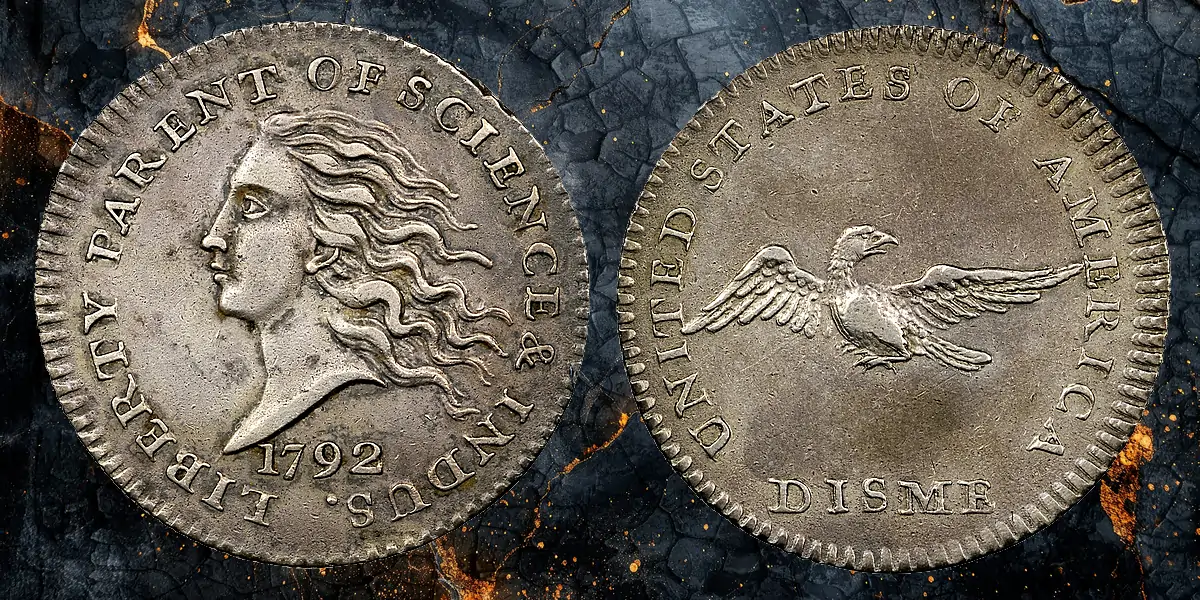
The 1792 P10C Silver Disme, Judd-9, Pollock-10, graded AU50 by NGC, weighs 41.5 grains. That matters. The Coinage Act of April 2, 1792 called for the disme to weigh 41.6 grains of standard silver. So this pattern sits almost exactly on the legal blueprint for the nation’s first 10-cent coin.
Only three silver dismes survive today. Two sit on thin planchets. One survives on a thick planchet. This AU50 example ranks as the finer of the two thin-planchet pieces. In January 2015, as part of the Donald G. Partrick Collection, it realized $998,750 at Heritage Auctions.
That price reflected rarity. However, it also reflected something deeper. This coin represents the dime before Americans called it a dime.
Before the Dime, There Was the Disme
The spelling looks odd today. In 1792, Congress used the word “disme” for one-tenth of a dollar. The same law also defined dollars, cents, and milles. In other words, Congress placed the decimal system into American money from the start.
That choice mattered. It broke with pounds, shillings, and pence. It also fit the young republic’s Enlightenment confidence in order, reason, and measurement. A dollar could divide cleanly into tenths, hundredths, and thousandths. No inherited royal system had to stand between Americans and their accounts.
The silver disme brought that idea into metal.
On the obverse, Liberty faces left. Her hair flows behind her. Around her appears the motto LIBERTY PARENT OF SCIENCE & INDUSTRY. The date sits below the portrait. The reverse carries an eagle and the identity of the new nation.
The design does not look polished in the later Mint sense. It looks experimental. It looks urgent. Most importantly, it looks like 1792.
Rittenhouse, Washington, Jefferson, and a Missing Paper Trail
David Rittenhouse, the first Director of the United States Mint, moved quickly during the summer of 1792. On July 9, he requested Washington’s permission to coin half cents, cents, half dismes, and dismes. Washington approved the request that same day.
Then Jefferson stepped into the paper trail.
Jefferson advised Washington that routine Mint matters should not require the President’s direct attention. His advice made sense. A President should not need to approve every operational detail. Yet that practical advice created a numismatic problem. It may have reduced the surviving documentation for the disme.
Therefore, the silver disme entered history with less written evidence than the half disme. The half disme gained speeches, account-book entries, and generations of attention. The disme gained mystery.
And mystery always attracts collectors.
The Washington Silver Story: Powerful, Tempting, and Unproven
During the 19th century, collectors wanted coins with Washington connections. Dealers understood that. Auctioneers understood it too. A Washington link could turn an obscure early pattern into a relic of the founding generation.
By the 1860s, writers and dealers had begun to connect the silver disme to the same Washington silver story told about the half disme. Edward Cogan made that connection in 1864. Ebenezer Mason repeated a broader version in 1885. The American Numismatic Society’s 1914 exhibition catalog also grouped the silver disme and half disme together under the Washington silver tradition.
However, modern readers should slow down.
The Washington silver-plate story rests on much later recollection. It first entered the record in the 1840s through Philadelphia antiquarian John McAllister, who repeated a story attributed to retired Chief Coiner Adam Eckfeldt. That does not make the story false. It also does not make it proven.
For the silver disme, the evidence thins even more. The safest conclusion treats the Washington association as part of the coin’s collecting history, not as a settled Mint fact.
That distinction strengthens the story. The 1792 Silver Disme does not need legend to matter. Its legal weight, its experimental role, and its survival count already place it among the most important coins of the early republic.
Pattern Coin or First Dime?
The 1792 Silver Disme did not circulate like later dimes. The United States Mint did not begin regular dime production until 1796. Therefore, specialists classify the 1792 disme as a pattern.
Still, the word “pattern” can understate its importance.
This was not a fantasy piece made decades later. This was a 1792 experiment tied directly to the denominations Congress had just authorized. It tested a real 10-cent coin for a real monetary system. The silver example offered here also weighs almost exactly what the law required.
Copper dismes likely served as trial-metal pieces. That would have allowed early Mint workers to test dies and striking characteristics before using silver. Yet the precise striking order remains uncertain. Researchers continue to debate the earliest 1792 patterns and their sequence.
Even so, the larger point stands. The copper dismes and silver dismes belong to the first generation of federal coinage experiments. Together, they show the Mint thinking through design, metal, weight, and national identity in real time.
Only Three Silver Dismes Are Traced
Today, specialists trace only three 1792 silver dismes.
The finest thin-planchet example is this AU50 NGC coin. It weighs 41.5 grains. Dr. J. Hewitt Judd owned it by 1946 or earlier. Abe Kosoff offered it in An Illustrated History of United States Coins in 1962. Kosoff later reported that an anonymous collector bought it. Donald G. Partrick eventually acquired it, and Heritage sold it in 2015 for $998,750.
The second thin-planchet coin grades Fine 15 NGC and weighs 39.5 grains. Edward Cogan introduced it in connection with the J.P.W. Neff Collection in 1864, although the catalog did not list it as a regular lot. George Seavey bought it for $205, a huge price for the era. It later passed through the Parmelee, Steigerwalt, Granberg, Newcomer, Green, Newman-Johnson, Floyd Starr, Rick Sear, southern collection, and Bob Simpson channels. Heritage sold the Simpson example in 2016 for $329,000.
The third coin, Judd-9a, sits on a thick planchet and weighs 66.1 grains. NGC grades it XF Details. Its pedigree reaches back to Joseph J. Mickley and includes Mendes I. Cohen, Jules Fonrobert, George Ulex, Henry Jewett, Thomas Elder, E.H.R. Green, Eric P. Newman, Burdette G. Johnson, Wayte Raymond, the Norweb family, and Donald G. Partrick. Heritage sold it in 2015 for $458,250.
A possible additional 19th-century appearance complicates the census. The DeWitt Smith-Virgil Brand-Wayte Raymond coin remains untraced. Some researchers have tried to connect that appearance to the AU50 specimen, but the historical descriptions do not align perfectly. So, caution wins. Three silver dismes remain traced today.
A Coin With a Scar and a Second Strike Story
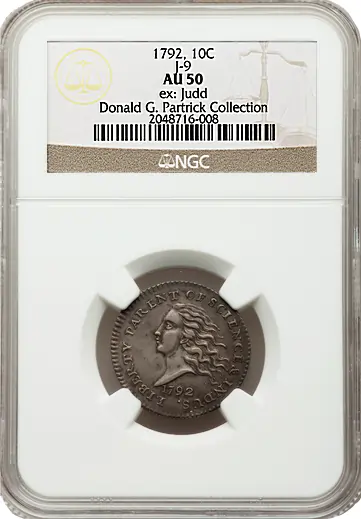
The AU50 coin carries the look of age without losing its authority.
Its obverse shows coin-gray toning. Deeper color gathers around parts of the design. A small hidden mark appears within Liberty’s hair, near the second E in SCIENCE and just above one extended strand. The reverse shows evidence of multiple strikes. Doubling appears in STATES and along the dentils near the top and right side.
Those details matter because they bring the coin back into the room where early Mint work happened. This was not a mature steam-powered operation. This was the Mint at the moment of invention. Dies, planchets, presses, and personnel all had to prove themselves.
In that context, the silver disme becomes more than a rarity. It becomes a workshop survivor.
Why the 1792 Silver Disme Still Feels Modern
Modern collectors often chase grade, population, and price. The 1792 Silver Disme offers all three. Yet its real power comes from something else.
It captures the moment America chose a decimal coinage and carries the language of Liberty, science, and industry. It reveals how quickly facts can blur into national myth. Also, it shows how a coin can remain famous among specialists while hiding in the shadow of a more widely known cousin.
The half disme may own the brighter spotlight. But the silver disme owns a different kind of importance.
It was the dime before the dime. It was the tenth before the word became familiar. And in this AU50 survivor, it still carries the weight Congress assigned to it in 1792.
That is why collectors treat the 1792 Silver Disme as more than an experimental coin. It is a founding document in silver.





Time to get my metal detector out go to secret spot.
Thank you for such a fascinating history! The story of the disme’s birth is especially interesting because it illustrates the nascent Mint’s steps – and missteps – on its way to creating a new coinage system.
To add a bit to the etymology of “disme”, my understanding it that it’s a direct derivative of the French “dixième” (roughly, “deez-YEM”) meaning one-tenth and was pronounced “deem”. Presumably both the spelling and pronunciation would have morphed to their current forms relatively quickly, given that eyes accustomed to English spelling would probably read “disme” as “DIZ-me” :)
I love silver.
Very nice, I admired those since I was a kid.
Great history on this coin. And the fact that there are still pieces from the early years of the U.S. is amazing.
Learn something new everyday, and the history orourcouns and the mint are so fascinating to me!
Science !
So cool
Great article, interesting coin.
I wish I could afford one.
I just learned something new. I’ve been collecting since 1964 and it’s great to learn something I didn’t know. Great article.
I’ve been collecting since 1962. Great article, I learned something new. There’s always something new to learn.
1792 was definitely a good year….from what I hear!
place a comment
Great article. Love this coin design.
Oh wow, I guess I have not seen this info on the 1792 before…what an interesting and rare piece of American history…Thank you for sharing this and other information with us..Happy 4th!!
Why can’t we design coins today with such strong symbolism to them anymore? The new 2026 Dime is the closest to a classic design in over ~ 80 years. Dead presidents on coins do not attract new collectors.
A beautiful rendition of Ms. Liberty.
better than the typical design we have today – classic
Thanks for an interesting article about a coin with a great history.
Great article
how enlightning
The 1792 Disme is a rare and historical coin stemming from the very early days of America. It is a true, significant Rarity reflecting America’s Numismatic History!!!
Fascinating that something that old can be in such good condition.
What a great condition coin for that age. Thanks for all the information on the dime I did not know existed.
So cool! One day I’ll own one of these early post-colonial pieces! Ahhhh, to dream.
I read the headline and thought I was having a stroke. Or that there was a spelling error through the entire article.
my bucket list dream coin
Great info
very interesting
Awesome piece of history
Amazing history on these coins. I want to go dig so bad I can hardly stand it. Thanks.
Never knew!
What a history to our beginning of the dime in our country….very informative and cool!
Very interesting.
beautiful coin
Interesting article
I looks incomplete. Very basic coin.
Sadly so few exist. Nice design.
Definitely a beautiful coin to me
Great article always love the history lessons here.
Nothing and no one had a high rate of survival back then.
Not gonna lie, I had to open the article to see if “disme” was a title typo. Cool history though.
An interesting backstory.
Nothing … dismal … about this story. (Groan). I’ll see myself out.,
Interesting
Good looking design!
Such a fantastic piece of American history. Happy 4th to everyone!
It would be great if a copper version showed up.
Very Interesting and informative.
Very cool, would be awesome to find one of these
Nice article. The Mint actually used the orthography terminology “disme” until about the time of the introduction of the Seated Liberty series. About the contemporary pronunciation, one wonders… In association with such words as “aisle”, “island”, “viscount”, “demesne”, and “isle” — all with the “silent S” — it would be reasonable to suppose that with the long “i” and silent “s” could have been pronounced as in “I’m”, thus “dEYEm.” In English, there are only a few instances wherein the letter “i” is pronounced as “EE” — typically as endings of foreign loan words (e.g. taxi, sushi). This is one reason why non-native speakers of English tend to have so much trouble avoiding using that long EE sound.
Interesting article, the word half dime sounds so crazy.
Always learning here
The exquisite Disme, absolutely one of the dimes of all time.
This is a very interesting article.
Disme, meaning 1/10th. Were they using the metric system back then?