


Few United States coin denominations have failed as quickly, or as quietly, as the Twenty-Cent Piece. Authorized in the mid-1870s and struck for only four years, this oddball silver coin never found its footing with the American public. Today, it survives as a fascinating numismatic footnote, prized more for its rarity and story than for its brief role in commerce.
The United States Mint produced the Twenty-Cent Piece from 1875 through 1878. However, circulation issues were limited to just two years: 1875 and 1876. By the final two years of production, the denomination had already been abandoned for commerce, with the Mint striking only Proofs for collectors. In total, just 1,100 Proof Twenty-Cent Pieces were sold across 1877 and 1878.
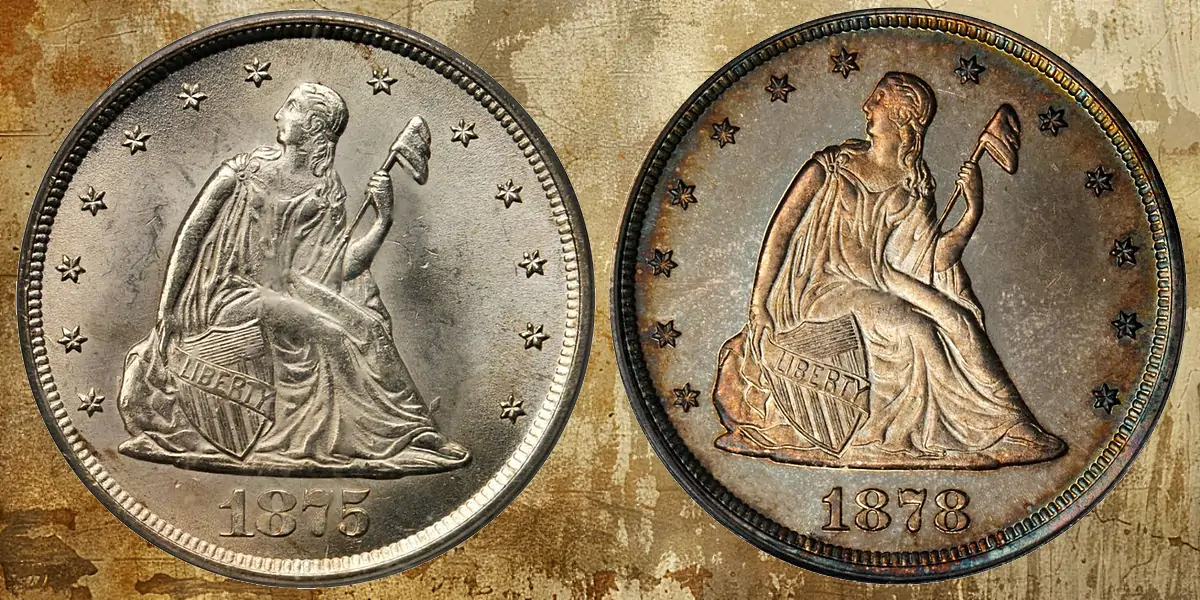
That short production window, combined with low survival rates, places the Twenty-Cent Piece among the most intriguing, and misunderstood, series in American numismatics.
Why Create a Twenty-Cent Coin?
At first glance, the Twenty-Cent Piece seems unnecessary. After all, the quarter dollar had circulated successfully for decades. Yet the coin’s origins lie at the intersection of politics, silver interests, and post–Civil War monetary policy.
Although proposals for a twenty-cent denomination date back to the late 18th century, the idea gained traction only after the Coinage Act of 1873 ended the free coinage of silver. That legislation, later dubbed the “Crime of ’73” by its critics, sent shockwaves through western mining interests.
In response, newly elected Nevada Senator John Percival Jones pushed Congress to authorize a new silver coin. Jones argued that a Twenty-Cent Piece would serve two purposes. First, it would provide an additional outlet for domestic silver production. Second, it could compete with European silver coins struck to the standards of the Latin Monetary Union in foreign trade.
Congress saw another potential benefit. With the half dime discontinued in 1873 and small-denomination coins struck only at the Philadelphia Mint, the western states faced persistent shortages of small change. A new silver coin, lawmakers hoped, could ease commerce west of the Mississippi.
On paper, the idea made sense. In practice, it did not.
A Design Too Close for Comfort
The failure of the Twenty-Cent Piece can be traced directly to its design.
Chief Engraver William Barber, working under Mint Director Henry Linderman, adapted the familiar Liberty Seated motif for the new denomination. The obverse closely resembled the quarter dollar, while the reverse featured an eagle of similar size and posture.
Yes, the Twenty-Cent Piece had a plain edge instead of the quarter’s reeded edge. However, that distinction proved far too subtle in daily commerce. Worn quarters often lost their reeding, making the two coins nearly indistinguishable in circulation. As a result, merchants and consumers frequently confused the denominations, often to their financial detriment.
Despite experimentation with pattern designs, the Mint never produced a coin that clearly separated the Twenty-Cent Piece from the quarter dollar. Public confidence eroded quickly, and acceptance never followed.
Mintages and Circulation Realities
The Twenty-Cent Piece was struck at three facilities: the Philadelphia Mint, the Carson City Mint, and the San Francisco Mint.
In 1875, the San Francisco Mint anticipated strong export demand and produced a substantial 1,155,000 pieces. Carson City struck 133,290 coins that year, while Philadelphia contributed just 38,500.
Fortunately for collectors, a meaningful number of 1875-S examples survive today in grades ranging from XF through Mint State. As a result, the issue remains one of the most accessible entry points for collectors seeking a Twenty-Cent type coin.
The following year told a different story.
The 1876-CC Twenty-Cent Piece was struck to a modest mintage of 10,000 coins. Nearly the entire production run was melted before release. Today, fewer than 20 examples are believed to survive, making it one of the great rarities of 19th-century American silver.
By 1877, the writing was on the wall. The denomination was dead.
Proof-Only Farewell
Although circulation strikes ended after 1876, the Mint continued to produce Proof Twenty-Cent Pieces in 1877 and 1878. These coins were struck exclusively for collectors, with mintages of just 350 and 600 pieces, respectively.
Many have since been lost, mishandled, or impaired. High-grade Proof survivors with strong eye appeal are legitimately scarce. and fiercely contested when they appear at auction.
Coin Profiles: Two Twenty-Cent Pieces We Love
1878 Twenty-Cent Piece, Proof-66 Cameo (PCGS), CAC
The 1878 Proof Twenty-Cent Piece represents the final chapter of this ill-fated denomination—and it does so with unmistakable elegance. Struck as a Proof-only issue with a mintage of just 600 pieces, the 1878 Twenty-Cent Piece is scarce in any condition. In high-grade Cameo format, it is genuinely rare.

This PCGS Proof-66 Cameo example, approved by CAC, displays the kind of visual drama collectors hope for but seldom encounter. The mirrored fields are deep and reflective, providing bold contrast against frosty, sharply defined devices. At the obverse periphery, rich gold and electric blue toning frame Liberty with remarkable intensity, while the centers remain brilliantly luminous.
The reverse is equally compelling. A classic “bullseye” toning pattern radiates outward from the eagle, transitioning through concentric rings of gold, orange, crimson, and deep neon blue. The effect is dynamic, balanced, and unmistakably original.
Technically, the strike is outstanding, with full definition throughout the stars, shield, and eagle’s feathers. Just as important, the eye appeal fully supports the assigned grade, placing this coin among the elite survivors of the series.
Provenance adds another layer of appeal. This piece resided in the Teich Family Collection for more than half a century, making its appearance at auction a true “fresh” opportunity—exactly the kind of coin that ignites strong bidding in today’s competitive numismatic marketplace.
As a capstone to the Twenty-Cent series, few coins speak more eloquently to both its promise and its premature end.
1875-CC Twenty-Cent Piece, MS-65 (PCGS), CAC
Among circulation strikes, the 1875-CC Twenty-Cent Piece stands as the undisputed cornerstone of the series. Struck at the Carson City Mint during the denomination’s inaugural year, the issue combines historical importance with genuine scarcity in high Mint State grades.
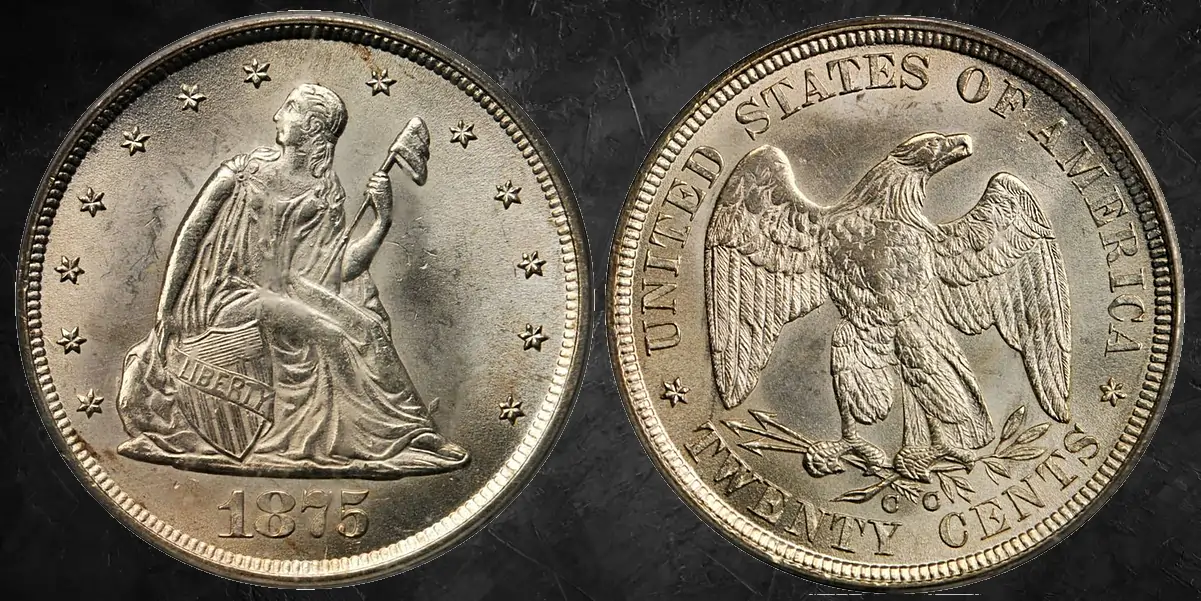
This PCGS MS-65 example, verified by CAC, represents the series at its finest. Both obverse and reverse are predominantly blast white, accented by the faintest whisper of golden patina. Strong, swirling mint luster animates the fields, while the devices display crisp frost and excellent contrast.
The strike is notably sharper than average for the issue. Although a trace of softness remains at the top of the eagle’s left wing—a known characteristic of the date—the overall impression is one of precision and care. Surface preservation is exceptional, with virtually no distracting marks visible under magnification.
Beyond its condition, the coin invites closer study of the denomination’s subtle design differences. The plain edge, raised lettering on the shield, and the bold “20 CENTS” inscription were all intended to distinguish the coin from the quarter dollar. Less discussed, however, is the reverse’s heraldic symbolism.
Here, the eagle grasps arrows in its right claw and an olive branch in its left—a configuration traditionally interpreted as prioritizing strength over peace. While this arrangement appeared on earlier U.S. coinage, its revival in the post–Civil War era feels curious and perhaps unintended, serving yet another attempt to differentiate the Twenty-Cent Piece from its quarter-dollar cousin.
In the end, this superb 1875-CC stands as both a technical triumph and a historical cautionary tale—proof that even well-intentioned coinage experiments can falter when execution misses the mark.
A Short Run, a Long Legacy
The Twenty-Cent Piece failed because it tried to solve too many problems at once—and solved none of them well. Yet its brief life has secured it a lasting place in American numismatics. For collectors, the series offers rarity, political intrigue, and undeniable charm.
Sometimes, the shortest-lived coins leave the longest impressions.
Read more CoinWeek articles on Twenty Cent Pieces
* * *




I don’t have any knowledge on this coin, but i found it fascinating.
Thanks for a great article about IMHO an underappreciated coin! I’ve always felt that the “double dime” is a coin we *should* have had, because it would have given us a more efficient set of denominations that follow a truly decimal 1-2–5-10 pattern. While by that standard the quarter could be treated as the real “oddball” coin, it of course wasn’t to be.
All collectors know that the quarter was born for compatibility with Spanish 8-reales pieces that co-circulated alongside early US coinage. Small change was made by actually cutting those coins into 4, 2, and 1-reale “bit” pieces. The new half-dollar denomination was already an exact match for 4 reales and the dime was close enough to 1 reale (12.5¢), but a 1/5 dollar coin would have been a cumbersome substitute for 2-reales pieces. Given the need for easy conversion and only the Russian ruble – which also had a 25-unit minor coin – as a possible model, creation of the quarter coin made perfect sense.
By the time Spanish coinage was demonetized 1857 the quarter had long been a workhorse denomination. Regardless of the benefits of switching to denominations used by most major countries today, withdrawing all those quarters in favor of 20¢ coins would undoubtedly have been at least as fraught as modern efforts to replace the inefficient $1 bill with $1 and $2 coins.
Best coin ever made. Had one a time ago. Gave it away. What a mistake.
Beautiful coin. Such craftsmanship.
My favorite eagle of any coin.
Would love to see this rarity in real life.
A very informative article on the short-lived, twenty cent coin.
Thank you for the article on the Twenty cent piece, very informative for a beginner collector as myself. Look forward to many more articles.
Interesting read and a great coin…short lived but very cool.
20 cent pieces are special
I’ve always been fascinated with the “why” of this denomination, especially considering they could have just made more dimes and quarters and still achieved their goals. Thanks for the excellent article!
Interesting read (in the year we had the demise of the penny).
This proves I was always a novice collector. I had no knowledge of this coinage.
Thanks for the interesting article. Reminds me if the Susan B. Anthony dollar being too close in size to the quarter.
@Ralph Mutschler: IMO the issue wasn’t so much the coin’s size as it was the Mint’s bullheaded insistence on using the same cupronickel cladding and reeded edges. Pennies (RIP) are closer in size to dimes than dollars and quarters, yet no one confuses them due to different metals and edges. As another example, Canada’s quarter and Loonie dollar are essentially comparable to their US counterparts but there’s no issue of confusion due to color and planchet differences.
A twenty cent piece was what got me interested in collecting coins. My grandfather left me a cigar box ful of old coins. I realized much later it was a type set of 19th century U.S. coins. The twenty cent piece was the first thing I saw, then the silver three cents, the large cents, the two cent piece and so on.
It got me hooked.
I have one for my type set, but the “double dime” seems to be the answer to a question that no one asked.
Very interesting article.
You think the powers that be would have learned not to make one coin too close in size to another… like a dollar coin…
Would love to own one !
Great looking coin
Always enjoy reading these historical articles!
I sure wish I owned one of these!
It was such a beautiful design but short lived I have only ever had the opportunity to buy one.
Good read on the double dime. I picked up a nice example last year, although it is a little dark.
I didn’t know America ever had a 20 cent piece.
I knew that these existed, but I never knew so much about the history of this coin! Great article!
what kind of price does a mint 75 bring?
A wishlist item
As a kid I recall my uncle having one. I do not recall what year or mint, Over the years it just disappeared. A few years ago I bought an AU 1875-S just because I did not wish to forget my fascination of such a unique coin. I may have overpaid, but I have no regrets.
The Seated Liberty coinage are definitely my favorite. I need the 20 cent piece and the dollar to round out my collection.
Very Interesting, Never heard of it let alone seen one..
one of my favorite coins too
I wish I had one of those.
A coin that was never really needed and poorly executed.
A coin that was never needed.
Love these coins and great read
I have never owned a 20 cent piece. It’s on my list!
Would love to own the proof coins
I’ve had several opportunities to acquire one and always let them go. Kicking myself now.
I have the 4 in NGC AU58.
Learn something new every day. I wasn’t aware of this denomination ever being minted.
Read this article to find out I was this many days old, that we had a twenty cent piece.
I never knew of this coin and its history. Still learning something new everyday.
Wow! Anyone would be lucky to have that in their collection.
Didn’t even know it existed. Interesting to think about a challenge of circulating coins minted in the east getting distributed out west.
Interesting coin but seemed doomed from the start
I have the complete 1875 and the 1876 Philadelphia. I wish I could afford the proof ones.
Beautiful coin.
The lesson of this coin being too close in size to the quarter was not learned by those who authorized the Susan B. Anthony dollar.
@William Based on what I’ve read about the SBA’s fraught creation process, its failure wasn’t so much its size but its design parameters. As I noted elsewhere, the Mint blindly ignored advice from numismatic experts – including its own Frank Gasparro – to give the new coin a distinctive shape and color. The dime and cent (RIP) are nearly identical in size but are never confused because of color and planchet differences.
Gasparro warned that using cupronickel and a reeded planchet would be a recipe for failure, but was ignored. He created his own design for a golden-colored dollar with an 11-sided planchet; the Mint demurred, saying that they couldn’t strike multi-sided planchets (!).
Of course our northern neighbors watched closely and struck their new, similarly-sized “Loonie” on 12-sided, brass-colored blanks that no one ever confused with a quarter.
I knew it was a short-lived denomination, but I didn’t realize it was THAT short-lived! It’s no wonder I have only seen 1875-dated examples. Now I need to add one to my collection!
I never knew about this coin. What a fascinating history!
Fun but pricey series
One of the problems with the twenty cent pieces was the similarity with the quarter and that is analogous to the problem with the Anthony dollar being confused with the quarter.
Neat.
I’ve never seen one!
Love the Eagle on the coin. I’ve never seen it before. When I think of a coin that didn’t work out/not popular, the Susan B Anthony dollar coin instantly comes to mind. At least The Sacagawea dollar coin couldn’t be confused with a quarter.
@Karen Dittrich: It’s still mind-bending that the Mint learned nothing from the double dime’s failure. They completely ignored expert recommendations to use a distinctive color and planchet for the new dollar. I belonged to a collectors’ group back when the prototypes were announced … all we could think was “No, not again !!”
I bought one in a pawn shop years ago. He had it marked as ’25c’, and priced accordingly. We were both smiling when I walked out of the shop.
Wow no idea these existed.
such a strange coin
@Roy Gruss A 20¢ coin isn’t strange by modern standards, though. It fits more efficiently into a decimal money system with ratios of 1 : 2 : 5, as opposed to quarters which introduce a fraction – 1 : 2½ : 5. That’s why 20¢ coins are typically used in countries that created their systems well after we did.
Could you imagine getting one of these back as change from a purchase today? Thanks for the article I never knew of the .20 piece.
2 cent penny, 20 cent piece…just interesting and love the old designs
Bring it back for fun.
I never knew there was a 20 cent coin until today! I would love one for my collection!
Interesting. When I first looked at the caption my thinking was that a twenty cent piece made sense. But then seeing the resemblance to a quarter, I could understand the confusion.
This is a coin I would consider collecting…if I can find one.
never knew about this coin – insteresting article
never knew this coin existed – thanks for the info
Interesting story, didn’t know this coin existed.
This article was very intriguing. I never knew of its existence. I love old coins and I would to have it in my possession. I really need to research more and read your articles.Thank you for the opportunities to win these incredible coins to all of us.
Never seen one.
I’ve tried to get this coin yrs ago, but can never find it at a decent price.
I love these coins, but they are really hard to find at any coin shop.
These coins are very hard to find at any coin shop, if you ask for them it will even take them a while to find them.
Wow! I have to add this coin to my collection!
I love the beauty of our early coins. It is unfortunate that this coin’s life ran out so quickly. Great images — incredible proof examples. Thank you for reviewing the history of this coin for us.
This is really cool!
Truly rare example of type American coinage. I have not ever owned one. I vaguely remember seeing one at a coin show. Did see a YouTube video of a particular metal detectorist finding one in the ground. Got to be a rarer event than seeing one at a coin show. Wow!
A rare coin indeed. I think I saw one at a coin show. Thank you for the article on this twenty cents coin.
Thanks for the interesting article.
I personally think that a 20 cent coin makes more sense than the quarter.
Best coin I ever had and looking again.
When I was young I had to have one these unusual denomination coins
Always great history on the page.
Interesting article