



By CoinWeek Notes …..
Background of the 1879 Indian Head Cent
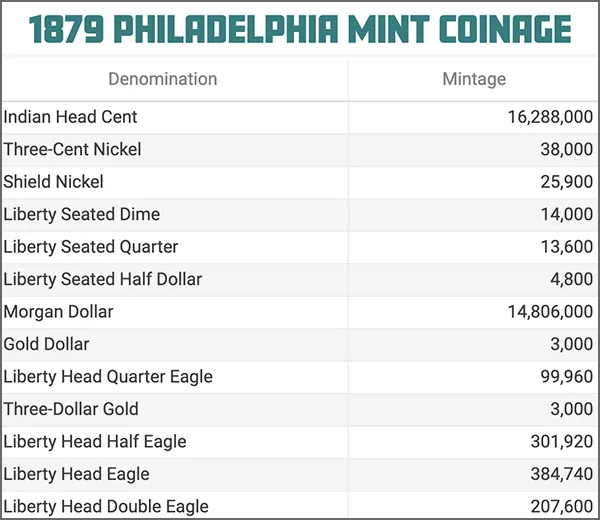
In 1879, the economic struggles caused by the Panic of 1873 had mostly subsided. Still, coinage output at the Philadelphia Mint reveals a mixed demand for many key denominations.
Curiously, the Philadelphia Mint’s output of 16,228,000 1879 Indian Head Cents represented the most coins struck of any denomination that year, surpassing the second-year Morgan Dollar issue by nearly 1.5 million.
The Mint also produced Liberty Head $5, $10, and $20 gold coins in decent numbers, but the other denominations received only a token coinage—a factor that contributes to their scarcity today.
In the years leading up to 1879, merchants were overwhelmed with one-cent coins and consequently flooded the Mint with cents for redemption. According to the Mint’s records, in 1879, 3.5 million cents were redeemed, and 3.3 million were reissued.
Typically, redeemed coins were melted down, the copper recovered, and new coins struck from the reclaimed metal. In 1879, however, the tide had turned: more coins were being issued for circulation than were being returned and melted down.
Because of this, coins from this date and subsequent years remain relatively abundant in both circulated and uncirculated conditions, leading some to refer to the sets of cents struck from 1879 to 1909 as the “Indian Head Cent Short Set.”
The 1879 Indian Head Cent in Particular
1879 Indian Head Cents are available in both circulated and Mint State conditions.
It’s a common misconception that in lower circulated grades, one must settle for a coin with significant damage or unsightly features. On the contrary, even in grades like Very Fine (VF) or Extremely Fine (XF), collectors will have no problem locating visually appealing 1879 Indian Head Cents.
- A pleasing Very Fine (VF) example typically ranges from $20-$45, depending on the exact grade and eye appeal.
- Collectors can purchase uncertified examples in About Uncirculated (AU) condition for $50-$100, with prices varying based on the specific level of wear and overall aesthetic appeal. Certified examples will cost more to compensate for grading fees and marketability.
Collecting Mint State 1879 Indian Head Cents
Those interested in Mint State coins should only buy certified examples graded by CAC, NGC, or PCGS. For Mint State copper, it is essential to understand the three color attributes, as they are significant factors that influence value and scarcity:
- Brown (BN): Coins that have entirely lost their original red luster and display a uniform brown color. Brown is the most common attribute for vintage copper coins.
- Red-Brown (RB): Coins with a mix of original red luster and brown toning. These typically command a modest premium over Brown examples.
- Red (RD): Coins that retain at least 95% of their original red luster. These are the most desirable and, consequently, the most expensive.
Expect to pay a premium for full Red examples. For a choice MS64RD with good eye appeal, prices generally start around $600-$700, though exceptional pieces can certainly realize more. The majority of 1879 Indian Head Cents found with significant original red luster will fall within the MS64 to MS65 grade range.
Conditional Rarity at Higher Grades
The 1879 Indian Head Cent becomes a conditional rarity at MS66RD and finer. At these levels, examples routinely sell for $9,000 or more.
Market Data and Noteworthy Specimens
As of December 2007, PCGS had certified 54 coins in MS65RD, with 16 finer. In 2023, Stack’s Bowers sold two PCGS MS67RD coins. During that same year, PCGS increased the MS67RD population from four to five.
Top Population: PCGS MS67+RD (1, 6/2025), NGC MS66RD (4, 6/2025), and CAC MS66+ (1, 6/2025).
- PCGS MS67+RD 46448365: As PCGS MS67RD #46448365: Stack’s Bowers, March 21, 2023, Lot 3083 – $22,800. There is a small carbon spot in Liberty’s hair to the lower right of her ear. Thin diagonal scratch to the right of the date. Machine doubling on the legend. Two small indentations to the right of ONE. As PCGS MS67+RD 46448365. The Alan L. Epstein Set Registry. Imaged on PCGS CoinFacts. Upgraded by 1/2 point. The carbon spot has been removed.
- PCGS MS67: As NGC MS67+RD #6329252-005: Heritage Auctions, October 6, 2022, Lot 3013 – $9,900; Heritage Auctions, May 4, 2024, Lot 3552 – $8,400. Crossed to PCGS, where it was downgraded by 1/2 point. Plated on CoinFacts. Dark streak to the upper left of O of OF.
- PCGS MS67RD #47311327: Stack’s Bowers, November 14, 2023, Lot 3011 – $16,800.
Design
Obverse:
Liberty’s face on the Indian Head Cent is similar to U.S. Mint Chief Engraver James Barton Longacre’s Three-Dollar Gold piece, and also bears resemblance to his Gold Dollar and double eagle Liberty portraits.
Wearing a beaded necklace, Liberty faces left. On her head is a nine-feathered Indian war bonnet with a band displaying the word LIBERTY. Locks of hair drape down the back and one end of the diamond-patterned headband curls slightly to the front, with the other end somewhat hidden between the hair and the bottom feather.
UNITED STATES follows along a denticulated border to the left while OF AMERICA follows along the right. The date is at the bottom.
Reverse:
The reverse has a concentric two-part wreath inside a denticulated rim, tied together at the bottom by a ribbon that also binds three arrows. The wreath is mostly composed of oak leaves with acorns, though another type of leaf is shown at the bottom on the left side.
The top ends of the wreath separate to allow for the placement of a small Union shield and the denomination ONE CENT is prominently displayed in the center of the flan.
Edge: The edge of the Indian Head Cent is plain or smooth.
Coin Specifications
- Country: United States of America
- Year of Issue: 1879
- Denomination: One Cent (USD)
- Mintmark: None (Philadelphia)
- Mintage: 16,228,000
- Alloy: .950 copper, .050 tin and zinc
- Weight: 3.11 g
- Diameter: 19.00 mm
- Edge: Plain
- OBV Designer: James Barton Longacre
- REV Designer: James Barton Longacre
- Quality: Uncirculated
* * *





Very interesting coin. I’ve never seen one before.
Indian cents is my favorite collection. Just need the 1877. good article. thank you
Indian head cents are one of my favorites, regardless of condition. Such a beautiful design!
I guess the lesson is…hold onto your pennies.
Interesting article.
Very informative article! I would love to own at least one of these beautiful coins. I would be happy with one in any condition! I think they are fabulous!
I remember the first time I found an Indian Head penny in change. It peaked my interest, and when we would travel across the country to visit relatives, I would have my parents stop at banks along the way so I could buy a few rolls of pennies to sort through looking for “keepers”. Then the next town, turn in those pennies for more pennies to sort through. Glad they tolerated my young obsession.
I really like the indian head Pennies!
Beautiful Coin.
Great article. Thanks!
Thank you for the great collector information.
I remember finding an 1879 AU Indian Cent in circulation back in the early 1960’s.
Very Nice !
very informative
Absolutely beautiful coins!
I found the article interesting
Love these coins, currently I am working on completing a full set. Fortunately, they are still accessible.
When I was little you could find them in your change, Thanks for the memory.
A classic looking coin.
Bring these back.
Indian head cents remind me of my Dad. He collected these, buffaloes, and Mercs from pocket change.
I have found 2 indian head pennies in my change over the years. Now the penny is discontinued, guess that is the last time I pay 1 cent for an indian head!
hmm, intersting!
Love the old coins from Indian head to wheat. Good stuff!
One of my favorites
Dad loved them.
Very interesting!!! I get caught up in the details.
thank you for this information.
I have a slew of Indian Head cents in the mid to late 60’s when I was 12ish.
A traveling camper salesman stole them from me when we lived in the Atwater California area.
Not only did he screw me he got my mother too.
Timely considering the penny going away…
I’m a huge fan of this penny. This coin as with all other older US coins before dead presidents were put on them are works of art. I find the president coins for me, lack the artistic draw.
I hope that the end of minting the 1cent coin will bring an increased attention to its historical significance and as the physical asset of actually being there in time. Sentimentally I appreciate the cents worn down by the people who lived during this time. Like a rock shaped by the river water. A circulated set although not the same monetary value has just as much respectful value. Call it “experience”. It shows that it was there. Not like just words on paper. It was there!