


By Roger W. Burdette for CoinWeek
Collectors of Indian Head half eagles cherish a quintet of San Francisco Mint coins for their overall rarity. These issues include the 1909-S, 1910-S, 1911-S, 1912-S, and 1913-S.
The San Francisco Mint struck all five dates in limited quantities and promptly issued them to California and other West Coast states.
A Rare San Francisco Quintet
Within this group, the 1913-S half eagle stands out as unusually rare in Mint State 63, and collectors consider it almost unobtainable in MS 65 or MS 66.
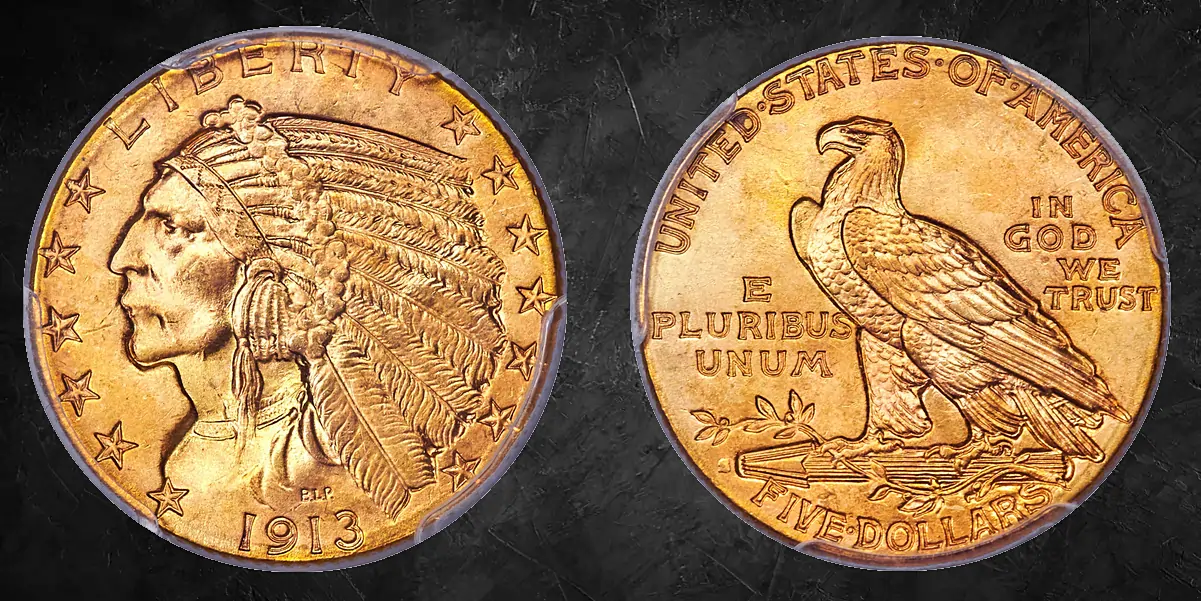
The 1913-S Half Eagle in High Grades
In 1988, David Akers commented on the peculiar quality of this issue:
“The strike is typically only average to good and the mintmark is usually very weak, and little more than a shapeless ‘blob.’ Problems near the border indicate die deterioration…and the luster is nearly always sub-par.”
Since then, most observers have shared this assessment. For example, top-tier auction descriptions frequently address the mintmark directly, as illustrated by this Heritage Auctions description:
“Although the mintmark is a trifle weak on this specimen, it is still completely visible and actually looks like an S, rather than the usual blob of metal seen on most specimens. The strike is substantially sharper than usual for the issue.”[1]
The Origin of the “Blob” Description
Accordingly, Akers, the Heritage cataloger, and many others have used the “blob” epithet to describe the mintmark on many 1913-S half eagles. The reason for this characterization appears clearly in the illustrations below, which show a sharply defined mintmark, two examples of a blob, and a more extreme “shapeless blob.”

The Die Deterioration Theory—and Its Limits
Based on Akers’ comment that “problems near the border indicate die deterioration,” collectors initially accepted this explanation as reasonable.
However, closer examination of production details raises questions.
The San Francisco Mint produced half eagles only in January and February of 1913. During that period, the mint delivered a total of 408,000 pieces on the following dates:[2]
Date and Value
- Jan 18 — $300,000
- Jan 20 — $240,000
- Jan 22 — $300,000
- Jan 29 — $320,000
- Jan 31 — $280,000
- Feb 13 — $320,000
- Feb 14 — $280,000
- TOTAL: $2,040,000
Although the mint used several mintmark locations and orientations in 1913, nearly all examples display similar defects. This consistency weakens the die deterioration theory, since it would require multiple dies to deteriorate in precisely the same area.
Mint Records Provide New Evidence
Fortunately, researchers no longer need to rely solely on observation. Advances in archival document digitization, transcription, and research methodology now provide access to primary evidence that addresses this puzzle directly.
Special Assay Coins and the Mint Bureau Process
At the time, each mint routinely sent two or three sample coins from every delivery to Mint Bureau headquarters in Washington, D.C. Officials referred to these pieces as “Special Assay” coins.
The assay lab weighed, examined, and tested the coins to confirm compliance with legal specifications, then reported its findings to both the mint director’s office and the originating mint. When unusual circumstances arose, the Bureau’s Assayer forwarded one of the Special Assay coins to the Philadelphia Mint so Engraver Charles Barber could examine it.
The January 1913 Discovery
Such a circumstance arose when the Mint Bureau received Special Assay coins from San Francisco’s Delivery No. 3, dated January 18, 1913.[3]
Although the coins passed all routine tests, Assayer Frederick P. Dewey noticed that the “S” mintmarks appeared barely legible. He immediately brought this problem to the attention of Director George Roberts.
Roberts responded by sending a fragment of one coin to San Francisco and forwarding a complete coin to Philadelphia for examination.
“I enclose part of a San Francisco coin and would direct your attention to the extreme obscurity of the mint mark and would be glad to have you explain the cause of this defect. The corresponding coin from the same delivery showed the same defect.”[4]
The Milling Machine Explanation
Within a few days, Dewey received an explanation from Engraver Barber and forwarded it to Superintendent Leach. Unfortunately, no copy of Barber’s explanation has been located.
“I enclose herewith part of one of the special assay coins representing Delivery No. 3 on which the mint mark is very indistinct. This piece has already been submitted to the Philadelphia Mint for examination and I enclose copy of their report. The second assay coin was even worse than this one.
Please return the piece of coin after you have finished your examination, and report upon it.”[5]
On February 19, Superintendent Leach wrote directly to Director Roberts and explained the cause:
“In reply to your letter of February 12th, in relation to the indistinctness of the mint mark on the special assay coin of half eagles, I would say that this defect was noted in our press room; and the cause of the trouble was hard to locate.
Finally it was found that the indistinctness was caused by a defect in the milling machine which failed to set up the edge of the planchet uniformly.
As the indistinctness of the mint mark was the only defect in the impression on the blank it was not thought of sufficient importance to condemn the work.
The authorities of the Mint at Philadelphia are in error as to the cause of the defect.
I return herewith the piece of coin you sent to us for examination.”[6]
How Many Coins Were Affected?
Unfortunately, Leach did not describe the specific defect in the milling machine. Nevertheless, the position of the mintmark provides an important clue. Because the mintmark lies closest to the edge, its relief depends on how the “S” punch was set when the die was prepared.
In addition, the absence of a fully defined rim may have interfered with proper metal flow during striking. Among U.S. Mint machinery, the milling, or “upsetting”, machine remains the least documented in terms of operation, repair, and maintenance.
As a result, the phrase “failed to set up the edge of the planchet uniformly” offers limited technical guidance. Because planchets entered the press in random orientations, the lack of uniformity must have affected the entire circumference rather than isolated areas.
When half eagle deliveries, correspondence dates, shipping intervals, and assay timing are considered together, it becomes likely that all January deliveries produced defective mintmarks.
In contrast, the $600,000 (120,000 pieces) struck in February appear to represent the primary source of examples with clearly defined “S” mintmarks.
Thus, collectors should expect roughly two-thirds of all 1913-S half eagles to exhibit defective mintmarks.
Acceptance at the Mint—and the End of the Issue
Ultimately, regardless of the precise mechanical cause, Superintendent Leach and Coiner William Cutter accepted the coins as satisfactory.[7]
As Leach stated:
“…As the indistinctness of the mint mark was the only defect in the impression on the blank it was not thought of sufficient importance to condemn the work.”
Director Roberts then sent a copy of the San Francisco explanation to the Philadelphia Mint, which effectively concluded the matter of the “blob” mintmarks.[8]
By
Roger W. Burdette
Copyright 2025. All rights reserved.
Citations
[2] RG104 Entry 273. San Francisco Mint deliveries by date and denomination, 1913.
[3] Deliveries were numbered in date order, often segregated by metal. For 1913 there were deliveries of double eagles on January 8 and 10. These would have been gold coin deliveries number 1 and 2.
[4] RG104 Entry 235 Vol 400. Letter dated February 7, 1913 to Frank Leach from Roberts.
[5] RG104 Entry 235 Vol 400. Letter dated February 12, 1913 to Frank Leach from Dewey.
[6] RG104 Entry 235 Vol 400. Letter dated February 19, 1913 to Roberts from Leach.
[7] In 1912 the position of “Coiner” was replaced by “Superintendent of the Coining Department.” This placed direct control of coining under the Superintendent; the once powerful Chief Coiner was now just another employee.
[8] RG104 Entry 235 Vol 400. Letter dated February 26, 1913 to Superintendent Landis from Roberts.





I would like to own this.
Interesting problem. I wonder what was the cause.
Nice looking coin
Thanks for all the history you provide!
I wih I had these in my collection
An amazingly beautiful coin!
Thank you for this history. Mystery solved!
interesting story
Many of us see something like a coin and think you put a blank in, punch it, and get a coin out. I never imagined how technically complicated something like how the blank was made could affect the final coin.
Another great article, thank you.
Fascinating article. Thank you.
Interesting article. Thanks for the history.
Interesting situation. If the upsetting mill were the problem (and affected the whole circumstance) I would think the lettering near the edge would be affected too. Anyway interesting to think about.
This is so cool to read about. My grandfather had an Indian Head half eagle, but I don’t know what year or mint. I also don’t know whatever happened to it. He had such a great collection of coins, but I have only a few from it.
One spectacular coin.
Wish I owned one of these “blobs.” Cool history. Thanks.
Learn something new everyday. I did know about the lobs.
Cool article. I love Indian head coins.
wow
Great looking coin.
Interesting information. It would be helpful if the comments from the engraver could be recovered.
There’s many ways to get a mistake.
Very interesting, and good to know what to look for on the coins one might have in their collection.
Accident???
Great article
I like blobs!
Very nice looking coin
A coin like this would be a crown jewel in my collection
A very good article