


By Charles Morgan and Hubert Walker for CoinWeek Notes …..
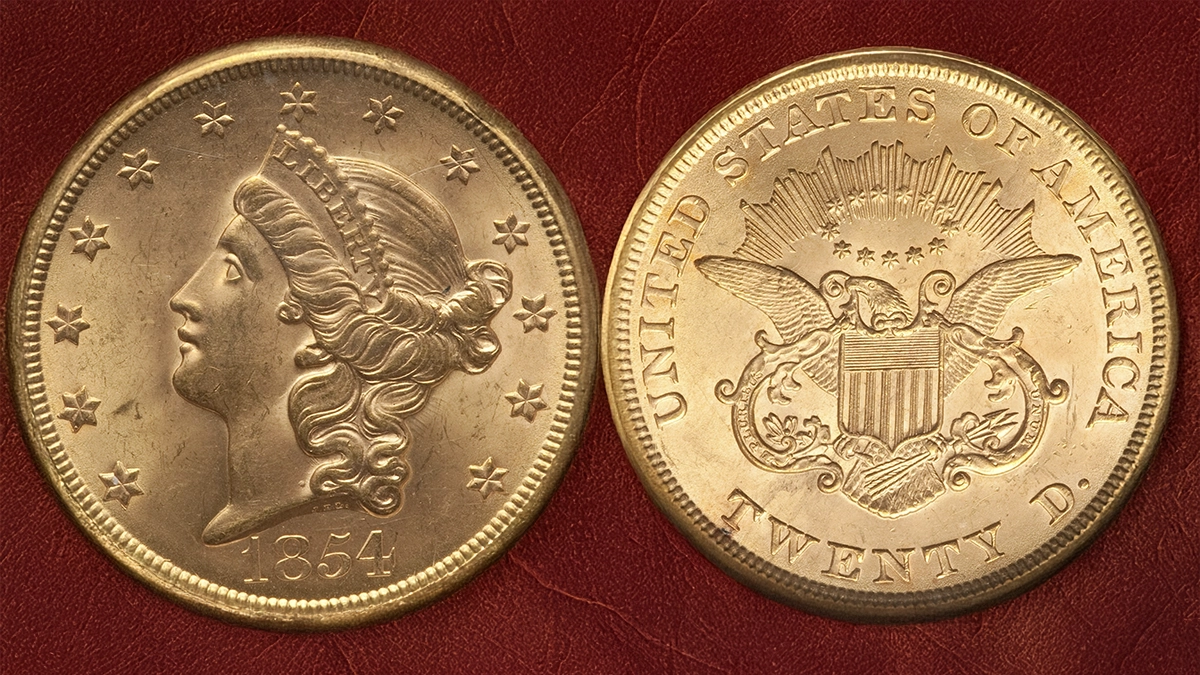
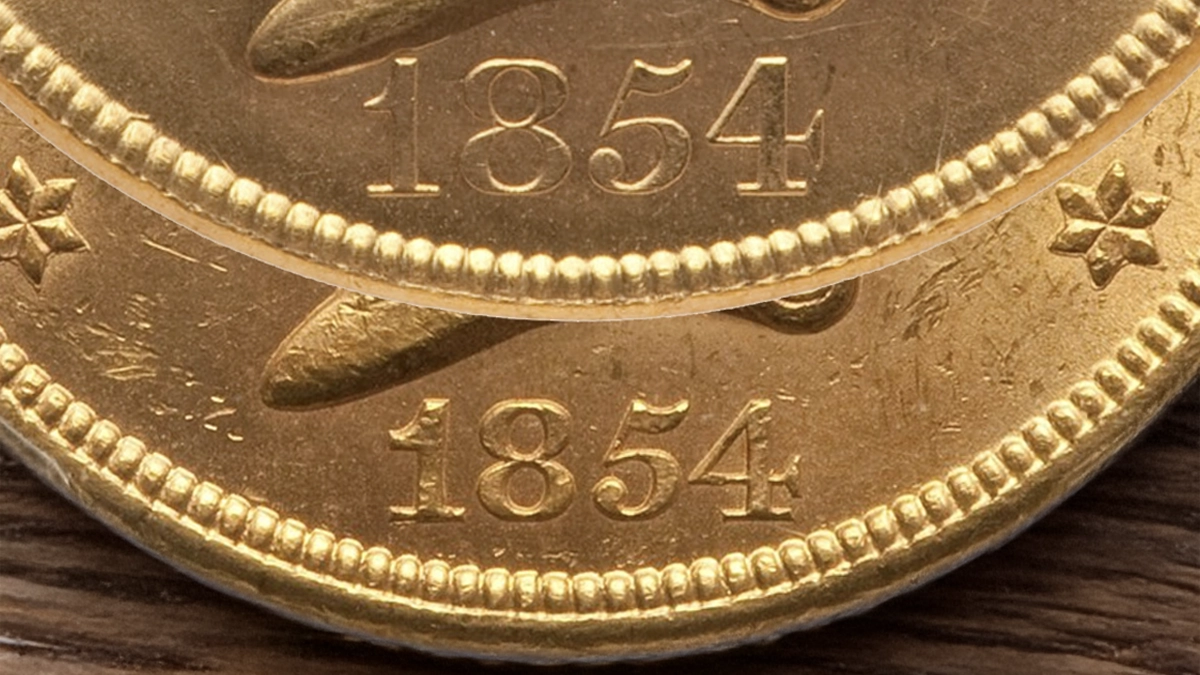
The Philadelphia Mint struck a total of 757,899 1854 Liberty Head Double Eagles. These coins can be categorized into two distinct date styles: the “Small Date” and the “Large Date.” Approximately 90% of the coins feature the Small Date, while the remaining 10% have the Large Date. The Large Date style is easily distinguished, as the numbers are larger and nearly touch the truncation of the bust.
Despite Economic Expansion, 1854 Marked a Continuation of the Country’s Unraveling
In 1854, the United States economy was a dynamic and expanding force, deeply influenced by westward expansion, burgeoning industrialization, and the ongoing impact of the California Gold Rush. While agriculture remained a dominant sector, particularly in the South, the North was rapidly industrializing, leading to significant shifts in the national economic landscape. The acquisition of a massive swath of territory following the Mexican-American War, along with the subsequent Gadsden Purchase in 1853, finalized the shape of the contiguous United States. These acquisitions also set in motion a growing series of conflicts that set the stage for the American Civil War.
While many in the general public were unaware of the dangerous path the country was on, talk of disunion was growing in the North and the South. At the center of it all was the issue of slavery. In 1836, the House adopted a “Gag Rule” to prevent the consideration of any anti-slavery petition, which led former President John Quincy Adams (then serving in the House) to present a petition from a group in Haverhill, Massachusetts, advocating for the dissolution of the Union due to the imbalance of resources benefiting slaveholders.
The animosity between the factions only intensified in the years to come as the Union continued to fray. Each side dug in, neither seemingly willing to abide by democratic outcomes that ran counter to their interests. By the early 1850s, nullification and secession were debated at conventions held in multiple Southern states. The influx of massive amounts of California placer gold may have significantly contributed to the country’s bottom line, but it alone could not alter America’s fortunes.
Still, the industrialization of the North continued at a brisk pace. By 1854, the United States trailed only France and Britain in manufacturing. The labor force was growing with the arrival of Irish and German immigrants, and the expansion of telegraph lines throughout the North created a network of interconnected financial and population centers. The agrarian South lagged significantly behind.
In 1853, industrialists in the United States saw increasing opportunities for economic advancement through trade in the Orient. Commodore Matthew Perry’s mission to Japan in 1853-1854 resulted in the Convention of Kanagawa, which opened Japan to American commercial interests and, in turn, increased trade with China.
While 1852 was the peak of the California Gold Rush, significant quantities of ore continued to be mined. A branch mint in San Francisco had been authorized that year by Congress. Future Confederate President Jefferson Davis, while not holding office when the authorizing legislation was being debated, supported the opening of a California mint when he had served in the previous session. The San Francisco Mint opened its doors in 1854; its facility was already laughably unsuitable for its purpose. Despite it being the “local” mint, a significant amount of gold continued to be transported to the east, where it was used by the Philadelphia Mint to strike gold coins for circulation in the Northeast and Midwest.
1854 Liberty Head Double Eagle, Small Date
Market Data and Noteworthy Specimens
Top Population: PCGS MS65+ (1, 7/2025). NGC MS62 (2, 7/2025), and CAC MS53 (1:0 stickered:graded, 7/2025).
- PCGS MS62 #56066857: Marketed at Heritage Auctions, August 2025, for $15,750.
- PCGS MS61 #34844046: S.S. Central America shipwreck recovery; Stack’s Bowers, August 16, 2023, Lot 5169 – $12,000. Bob Evans’ SS Central America signature label with a pinch of gold.
1854 Liberty Head Double Eagle, Large Date
Breen-7168. 10% of the surviving coins for the date. Large date logotype also used on 1854 Liberty Seated Dollars. 854 is evenly spaced. The “1” is slightly farther away, and its tip disturbs the line of the bust truncation. In 2004, Q. David Bowers postulated that only three to five were known in Mint State. From August 2012 to May 2015, PCGS population data indicated that the finest graded was a solitary MS64. Since then, a single MS64+ has been added to the census. Two Fairmont coins, plus a few others, doubles or triples the Bowers’ estimate of known Mint State examples.
Market Data and Noteworthy Specimens
Top Population: PCGS MS64+ (1, 7/2025). NGC MS62 (2, 7/2025), and CAC MS64 (2:1 stickered:graded, 7/2025).
- NGC MS64 #695901-002: Heritage Auctions, August 9, 2007, Lot 2010 – $80,500.
- PCGS MS62 CAC #46463633: “The Fairmont Collection-CAG Set,” Stack’s Bowers, March 22, 2023, Lot 5277 – $40,800.
- PCGS MS62 CAC #44882737: “The Fairmont Collection-Hendricks Set,” Stack’s Bowers, April 6, 2022, Lot 5372 – $43,200.
- PCGS MS61 #28539220: Dave Wnuck to Robert Galiette (Gilded Age collector), by sale, August 1997; As PCGS MS61 #28539220. “The Gilded Age Collection,” Stack’s Bowers, August 2014, Lot 12009 – $55,812.50. Plate coin in Walter Breen’s U.S. and Colonial Coin Encyclopedia (1988).
- NGC MS61 CAC #695901-002: Heritage Auctions, August 2007, Lot 2010 – $80,500; “The Marcello Collection,” Heritage Auctions, October 11, 2018, Lot 3196 – $102,000.
- NGC MS61 CAC #655313-011: Heritage Auctions, January 4, 2018, Lot 5093 – $31,200.
- NGC MS61 #3717000-016: “The Charles G. Wright Family Collection,” Heritage Auctions, August 7, 2014, Lot 5685 – $41,125; Heritage Auctions, April 27, 2017, Lot 4310 – $35,250.
* * *
Design
Obverse:
The obverse features a left-facing portrait of Liberty wearing an ornamental crown emblazoned with the word LIBERTY. On the bust truncation, Chief Engraver James Barton Longacre’s initials appear as JBL. Thirteen six-pointed stars encircle the design at the top. Date below. Beaded denticles at the rim.
Reverse:
On the coin’s reverse is the depiction of a bald eagle with its wings spread and its chest protected by a Coat of Arms comprised of a vegetal ribbon and a federal shield. The eagle clutches an olive branch in its right talon and a bundle of arrows in its left. The legend UNITED STATES OF AMERICA wraps around the design at the top. The denomination, written as TWENTY D., wraps around below. The mintmark O for New Orleans appears immediately below the eagle’s tail feathers. Beaded denticles at the rim.
Edge:
The edge of the Liberty Head Double Eagle coin type is reeded.
Designer(s):
James Barton Longacre (1794-1869) served as the fourth Chief Engraver of the United States Mint. Appointed by President John Tyler in 1844, Longacre had no prior experience with die-sinking when he took the position after the passing of Chief Engraver Christian Gobrecht. Longacre’s tenure at the Mint was marred by internal conflict with Coiner Franklin Peale and Mint Director Robert M. Patterson. Longacre outlasted both men and is credited as the designer of dozens of medals and U.S. coins, including the Liberty Head Double Eagle and the Indian Head Cent.
Coin Specifications
| Country: | United States of America |
| Year of Issue: | 1854 |
| Denomination: | Double Eagle ($20 USD) |
| Mintmark: | None (Philadelphia) |
| Mintage: | 757,899 |
| Alloy: | .900 gold, .100 copper |
| Weight: | 33.44 g |
| Diameter: | 34.00 mm |
| Edge: | Reeded |
| OBV Designer: | James Barton Longacre |
| REV Designer: | James Barton Longacre |
| Quality: | Business Strike |
* * *





Beautiful classic design
very informative