By Charles Morgan and Hubert Walker for CoinWeek Notes …..
Production of the 1861 Liberty Seated Dollar occurred during a period of great stress for the United States of America and the United States Mint. It was during this year that the war between the states began, kicking off five years of bloodshed, destruction, and economic hardship for the American people.
Before the first 1861 Liberty Seated Dollars were ejected from the Philadelphia Mint’s coin presses, the states of South Carolina, Mississippi, Florida, Alabama, and Georgia had seceded from the Union and entered into rebellion against the authority of the Federal Government. Louisiana seceded on January 26, taking with it the New Orleans Mint. The power to coin money, enumerated in Article I, Section 8 of the United States Constitution as being within the purview of the United States Congress, now faced a hostile government gaining control of its facilities, its bullion, and its coin dies.
The Federal Government was right to be worried, as the seceding states and then later the Confederate government did seize the bullion on hand. With coin dies previously shipped to the branch mints from Philadelphia, the precious metal was used to strike coins in the war’s opening months.
On February 8, Mint Director James Ross Snowden wrote to Treasury Secretary John Adams Dix, recommending that either Congress or the president rebuke the legal tender status of 1861 “O”-mint coins since the branch mint was no longer operating legally. This did not come to pass. Twenty days later, Dahlonega Mint Superintendent George Kellogg filed his final report to Mint Director Snowden, informing him that the Georgia mint’s total coinage consisted of 1,597 1861-D Liberty Head Half Eagles struck in January and February.
On March 4, The Congress of the Confederacy passed a resolution calling for the New Orleans and Dahlonega Mints to remain open and strike coins for the Confederacy. A month later, North Carolina Governor J.W. Ellis seized the Charlotte Mint. By this point, the Philadelphia Mint had struck 72,000 of the 77,500 business strike silver dollars it would issue in 1861. One thousand 1861 Liberty Seated Dollar Proofs were struck on April 15, three days after Confederate forces fired on Fort Sumter.
|
Production of 1861 Liberty Seated Dollars |
|||
| January 24, 1861 | 21,000 struck | January 28, 1861 | 12,000 struck |
| February 26, 1861 | 17,000 struck | March 8, 1861 | 6,000 struck |
| March 12, 1861 | 7,000 struck | March 19, 1861 | 9,000 struck |
| April 15, 1861 | 1,000 struck (Proofs) | June 25, 1861 | 5,500 struck |
| Total Mintage: 77,500 coins + 1,000 Proofs | |||
Silver dollar production would not reach these levels until after the war. Widespread hoarding in the eastern United States necessitated the issue of paper money (Greenbacks), and gold and silver coinage did not fully return until the passage of the Specie Resumption Act of 1875 – although silver dollar mintages began to see real increases starting in 1868.
As for the circulating history of the 1861 Liberty Seated Dollar? While it is true that many American silver dollars were struck for commercial export, the 1861 was struck and largely held by the Treasury Department until the need arose to melt them down and reclaim the silver for other coinage. This culling of a large portion of the mintage leaves a likely surviving population of fewer than 500 pieces; fewer than 300 have been certified.
How Much Are 1861 Liberty Seated Dollars Worth?
The 1861 Liberty Seated Dollar, like many Liberty Seated Dollars, survives in sufficient numbers to be collectible but is still scarce and may be priced beyond what most collectors can afford. Even in circulated condition, coins start at $3,000 for Extra Fine and advance to about $7,500 to $8,000 for a Premium About Uncirculated example (such as this PCGS AU58, which sold for $8,100 at a June 2023 Stack’s Bowers auction). Buying a certified example is a must as counterfeits of 19th-century coins continue to proliferate online.
Mint State auction appearances echo the scarcity of the issue. A limited number of coins are available at modest prices in the MS63 and MS64 grades. We expect the right coin to sell for $16,000 to $18,000 in MS64 and $9,000 to $12,000 in MS63. CAC, NGC, and PCGS have certified a total of nine Gem 1861 Liberty Seated Dollars; we have been able to identify eight discreet examples in our table below.
* * *
1861 Liberty Seated Dollar Market Data and Noteworthy Specimens
Top Population: PCGS MS66 (1, 3/2025), NGC MS65 (3, 3/2025), and CAC MS65 (1:0 stickered:graded, 3/2025).
- PCGS MS66 #02070132: Del Loy Hansen. Imaged on PCGS CoinFacts. Brilliant and lustrous. Scattered light ticks on Liberty’s face. Small hits on both breasts. Gouge above right shoulder. On the reverse, there is a deep gouge above the eagle’s right wing and a long curved scratch above the eagle’s left wing.
- PCGS MS65+ #25596544: Legend Numismatics to Eugene H. Gardner, by sale, April 2011; “The Eugene H. Gardner Collection, Part III,” Heritage Auctions, May 12, 2015, Lot 98567 – $50,525. Champagne hue. Deep horizontal gouge on the reverse below the eagle’s right wing.
- PCGS MS65+ #06559112: Imaged on PCGS CoinFacts. Champagne hue throughout, golden toning along periphery. Die cracks from arrow tips through second A of AMERICA.
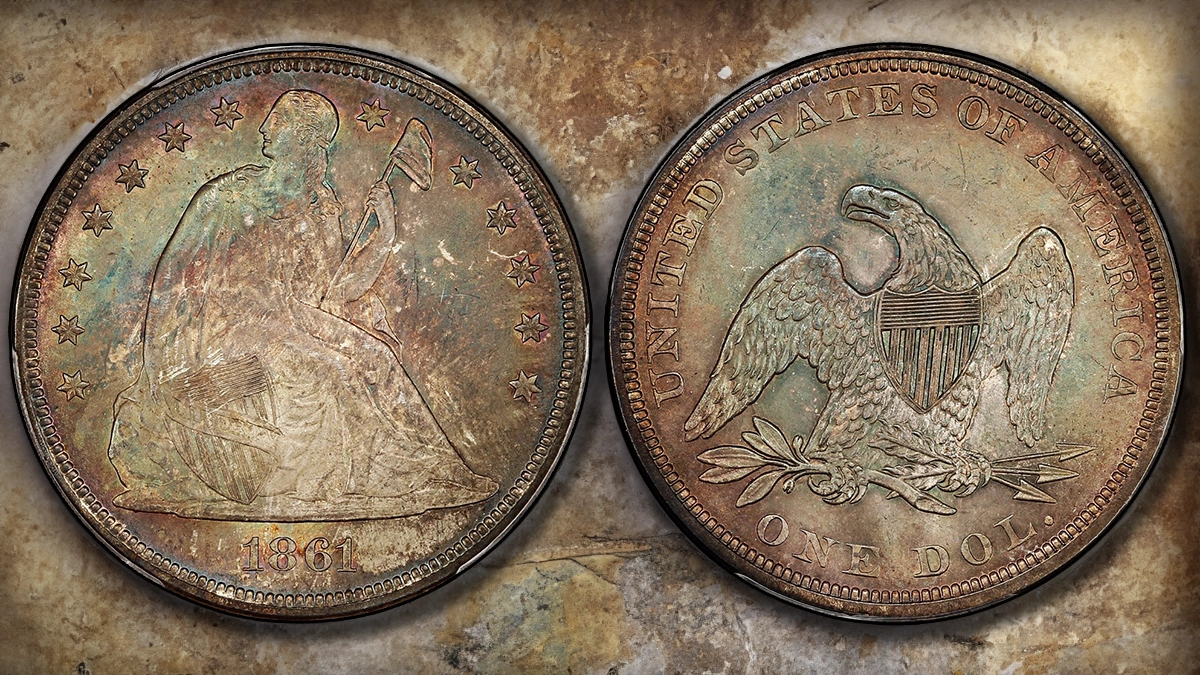
- PCGS MS65 CAC #81226399: Bruce Morelan; Del Loy Hansen; David Lawrence Rare Coins, November 10, 2019, Lot 614208 – $61,500. D.L. Hansen novelty insert. Olive, russet, and green toning throughout.
- NGC MS65 #12861861-006: “The Larry H. Miller Collection,” Stack’s Bowers, December 17, 2020, Lot 1097 – $32,400.
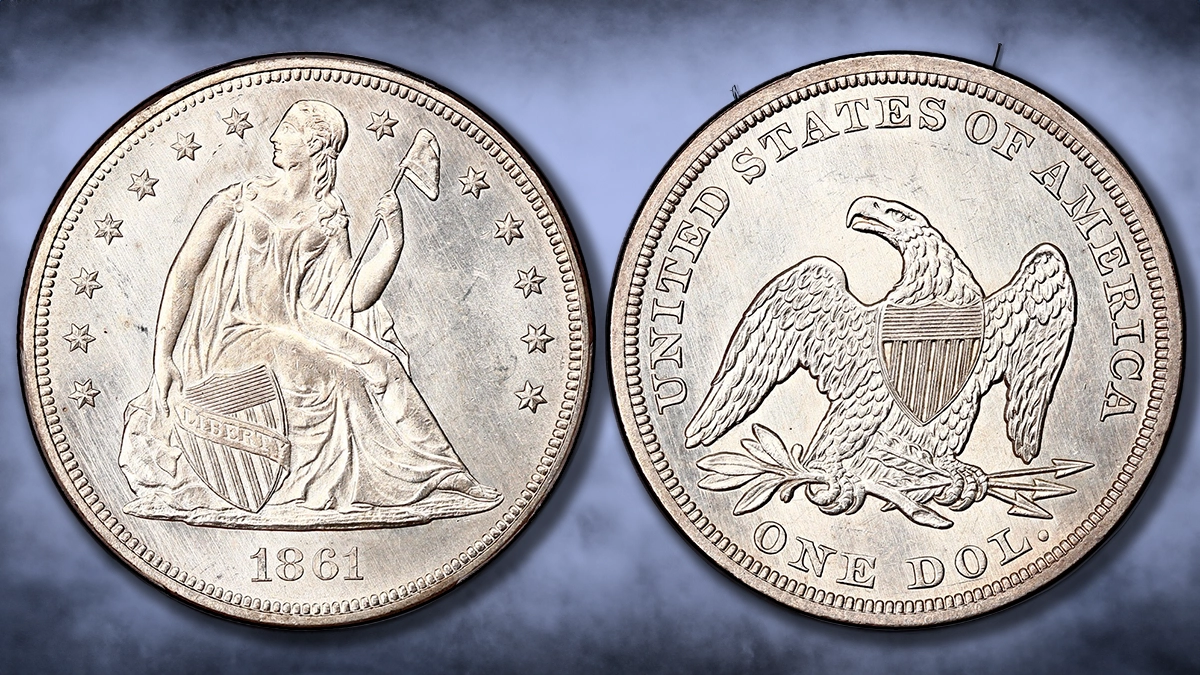
- PCGS MS65 #06634442: Stack’s Bowers, August 13, 2011, Lot 7416 – $43,125; Heritage Auctions, January 4, 2012, Lot 3304 – $46,000; Heritage Auctions, August 3, 2012, Lot 5187 – $44,127.13; David Lawrence Rare Coins, July 15, 2018, Lot 576322 – $43,775. White (dipped?). Deep hit on Liberty’s jawline and décolletage. Dark spot to the left of star 1. Rim hit between stars 6 and 7.
- NGC MS65 #1870196-002: “The Queller Family Collection of Silver Dollars,” Heritage Auctions, April 17, 2008, Lot 2119 – $46,000. Blue and purple rim toning. Muted silvery-grey centers.
- NGC MS65: “The Norweb Collection,” Bowers and Merena, November 7, 2006, Lot 486 – $19,320. Gold, heather, and blue toning.
- PCGS MS64+ CAC #26641622: Legend Rare Coin Auctions, July 16, 2020, Lot 12 – $19,387.50. Gold, auburn, and blue toning.
- PCGS MS64+ #25343387: Heritage Auctions, March 21, 2014, Lot 10467- $12,337.50. Scattered salmon toning on head and upper obverse. Light champagne hue throughout.
* * *
Design
Obverse:
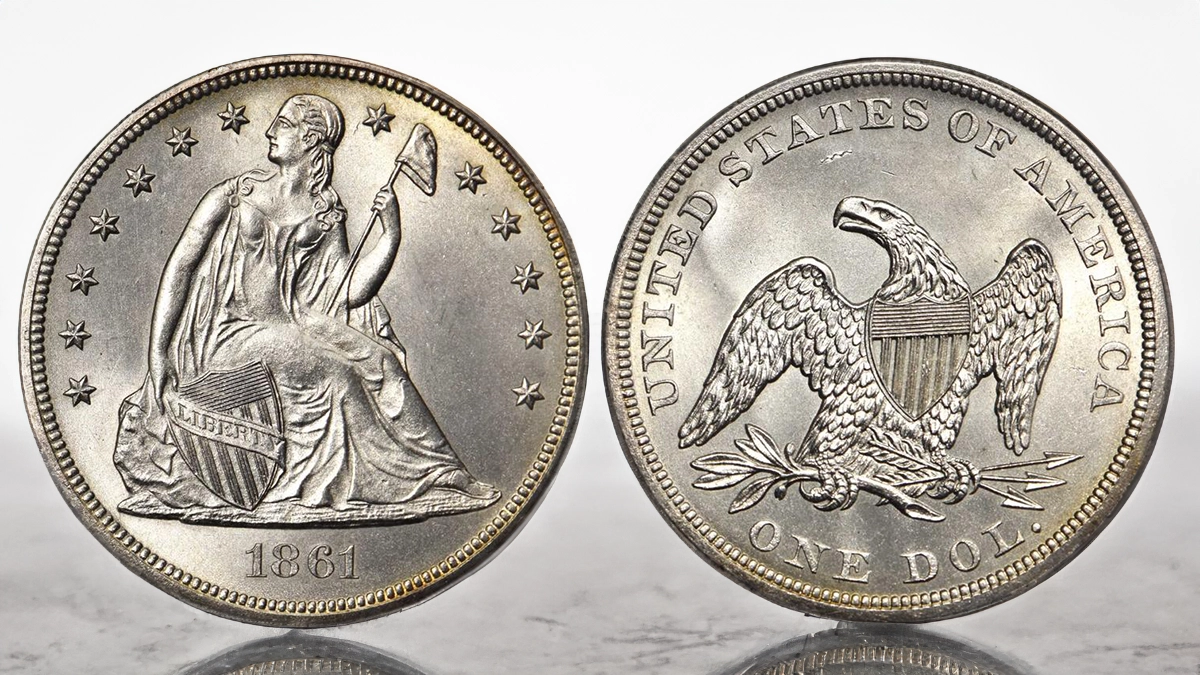
The obverse features Liberty seated on a rock in classical flowing robes, her head turned to the right (viewer’s left). She bends her left arm and holds a Liberty pole with a cap in her raised hand. The right arm is extended downward at her side, with the hand balancing a shield with the word LIBERTY displayed in a curving banner. Thirteen six-pointed stars surround the seated figure inside a denticulated rim with seven on the left side, one between Liberty’s head and the cap, and the remaining five along the right. The date 1861 is centered at the bottom between the base of the rock and the rim.
Reverse:
On the reverse, an eagle is prominently displayed inside a denticulated rim. The eagle’s wings are partly spread but folded downward at the joint as if the majestic bird had just landed or perhaps instead is preparing to fly away. An olive branch is in the dexter claw (viewer’s left); the sinister claw clutches three arrows. The legend UNITED STATES OF AMERICA encircles the top two-thirds of the coin inside the rim, with the ONE DOL. denomination centered at the bottom. Most were minted in Philadelphia and have no mintmark; branch New Orleans (O) and San Francisco (S) mintmarks are located below the eagle and above the denomination.
Edge:
The edge of the 1861 Liberty Seated Dollar is reeded.
Coin Specifications
| Country: | United States of America |
| Year of Issue: | 1861 |
| Denomination: | One Dollar (USD) |
| Mintmark: | None (Philadelphia) |
| Mintage: | 77,500 |
| Alloy: | .900 silver, .100 copper |
| Weight: | 26.73 g |
| Diameter: | 38.10 mm |
| Edge: | Reeded |
| OBV Designer: | Christian Gobrecht, from sketches by Titian Peale/Thomas Sully |
| REV Designer: | Christian Gobrecht |
| Quality: | Business Strike |
* * *
References
Julian, R.W. “The Silver Dollar, 1853-1873”, Numismatic Scrapbook Magazine. August 1964. 2124-2128. Data compiled and analyzed from the National Archives.
* * *