By Charles Morgan and Hubert Walker for CoinWeek Notes …..
Consumers in San Francisco and along the West Coast were handling a rarity in the mid-1860s.
As their counterparts in the east were disappearing from circulation during the Civil War, silver coins in San Francisco were circulating much more extensively – including the 1864-S Seated Liberty Quarter, which turned out to be a major rarity. People might have known that the freshly-struck quarters were prized in the east for their silver content but they might not have suspected that, decades later, the coins would be sought-after by collectors interested in their scarcity, not their precious metal.
The new branch mint began striking silver quarters and half dollars in 1855[1], even though, according to numismatic researcher R.W. Julian, “silver was not especially plentiful in California, most of it at that time being obtain as a by-product of gold mining[1]”. Gold bullion deposited at the San Francisco Mint contained 11% silver[2].
Nine years later, the facility would strike the fewest Seated Liberty Quarters of any year of the type. The 1864-S has the lowest recorded mintage of any Seated Liberty Quarter struck at the San Francisco Mint at 20,000[3]. Mintages of quarters at San Francisco in the 1860s were low (especially when compared to the 1870s); only 28,000 1866-S quarters were struck[4].
The economic uncertainty brought on by the Civil War drove coins from circulation in the east, forcing consumers to contend with an array of substitutes: fractional currency notes, encased postage stamps, Civil War tokens, Demand notes, and United States notes, among others[5]. The suspension of specie redemption deepened fears of economic collapse and further drove coin hoarding. Richard Doty explains in America’s Money, America’s Story (2008) that “Lincoln’s government floundered about for a number of years in search of a reliable, stable, but expendable fiscal medium[6].”
San Francisco experienced different problems. Specie was less valuable to people in the rapidly expanding city, as numismatist David Lange explains in History of the United States Mint and Its Coinage (2005):
“The withdrawal of gold and silver throughout most of the country was little noticed in the West. In a remote land where commodities were scarcer and more highly valued than cash, subtle variations in the relative values of gold and silver simply had no impact[7].”
Lange elaborated in the Numismatic Bibliomania Society’s E-Sylum in 2019 that “nothing [no denomination] smaller than a dime was in general circulation in California” in the 1860s[8].
With a large supply of gold and a population accustomed to unusual currency, sometimes reckoning prices in pinches of gold dust, far removed from most of the war’s carnage, coinage from the San Francisco Mint circulated much more extensively. This extended circulation resulted in what Heritage Auctions referred to in a 2017 listing as a “paltry survivorship” for the 1864-S quarter[9]. A Heritage Auctions listing from April 2019: “most of [the 1864-S quarters] circulated to attrition in the ‘hard money’ dependent West Coast economy[10].”
According to Larry Briggs, author of the Comprehensive Encyclopedia of United States Liberty Seated Quarters (1991), the coins were struck from one Type II obverse die and a pair of Type I reverse dies with a large “S” mintmark. Only one example was struck from the second die is known, according to Briggs[11]. Greg Johnson, a member of the Liberty Seated Collectors Club (LSCC), corroborates this in an email interview, adding: “They [the San Francisco Mint] never did convert to the Type II No Motto reverse[12].”
The typical well-preserved example of the issue will exhibit evidence of repunching of the first two digits of the date. As this feature wears down, the 1 may take on a blobby appearance.
An article written by Johnson and published in the E-Gobrecht, the online newsletter of the LSCC, in 2018 shared that a 2007 survey of LSCC members showed that the 1864-S quarter was the third-rarest Seated Liberty quarter stuck at San Francisco in members’ collections and the rarest No Motto piece from that mint[13]. In 1986, it was the rarest No Motto Seated Liberty quarter in club members’ collections[14].
The 1864-S quarter was voted among the “Ten Greatest San Francisco Seated Coins” in the March 2007 edition of the Gobrecht Journal[15]. 41% of respondents placed the issue in the top six entries on their lists[16]. Johnson elaborates that “[h]istorically, the 1864-S has been quite highly regarded as a rarity in the Liberty Seated quarter series[17].”
Because of its small mintage and extensive circulation, very few examples exist in About Uncirculated or Mint State, and such coins command high prices at auction, though John McCloskey explains that “[w]hile a rare date this issue [1864-S quarter] is not as difficult to find in mint state as several of the other early San Francisco quarters[18].” McCloskey’s study did point out that the coins were as rare as the rarest of the type in grades ranging from Choice Very Fine to About Uncirculated[19].
Johnson corroborated this in 2018, but offered that “recently, the scarcity of this issue on the market has only been more pronounced[20].”
The Eliasberg-Clapp Specimen
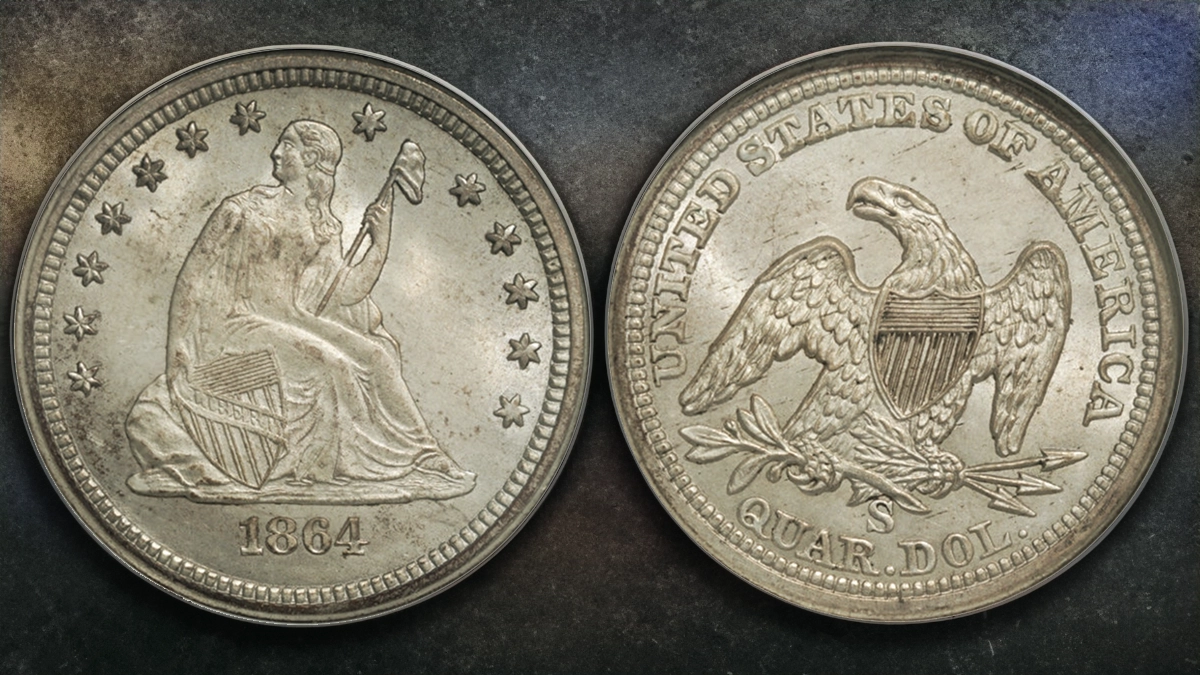
The finest-known 1864-S Seated Liberty Quarter is the Eliasberg-Clapp specimen, certified MS-68 by NGC. Part of the Eliasberg Collection, the coin fetched $82,800 when it sold in a Heritage auction at the Florida United Numismatists (FUN) Show in January of 2004[21][22]. NGC’s website said that the coin “simply defies belief”. Eliasberg bought the coin in 1942; it was sold raw by Bowers and Merena Galleries in April 1997 for $104,500[23]. It was certified in November 2003[24].
The coin sold again in August of 2006 for $112,700 in the Bowers and Merena auction at the 2006 Denver ANA Show[25]. In 2007, the coin was offered again at the Stack’s Brooklyn Sale and John Jay Ford XVII auction but was passed after not meeting the reserve.
Eliasberg purchased the coin in a private sale from the Clapp Collection, assembled by John M. Clapp, a Pittsburgh businessman and Civil War veteran who became a numismatist late in the 19th century[26]. Clapp became a serious collector in the late 19th century, participating in many of the period’s major auctions, and continuing into the early 20th century; he died in 1906[27]. His son John H. Clapp became an accomplished numismatist in his own right, and the collection both men assembled was sold to Louis E. Eliasberg Sr. in 1942, after John H.’s death in 1940[28].
The Clapp Collection contained many rarities and John M. purchased coins with mintmarks, a specialty of his, directly from the branch mints beginning in the 1890s[29][30].
Clapp bought the 1864-S quarter from the William M. Friesner Collection in 1894[31].
* * *
Market Data and Noteworthy Specimens
Though the Eliasberg-Clapp specimen is the finest known, other Mint State 1864-S quarters sell for high prices. An example graded MS-64 (the third-finest known) sold for $21,737.50 USD in July of 2020, after selling for $41,688 a dozen years earlier[32].
Circulated examples routinely sell for around $2,000 at auction, underscoring their appeal and rarity.
Even the more common circulated 1864-S quarters bring handsome sums at auction. An example from the Ed Lee McMillian Collection certified VF-25 by PCGS sold in a Heritage auction for $1,981.20 on January 24, 2021[33]. An example from the Poulous Family Collection graded Good 6 sold for $810 in September of 2019[34].
Even coins that don’t “grade straight” command high prices. An 1864-S quarter certified Fine Details – Cleaned sold in a Heritage auction in May 2020 for $750[35].
Top Population: PCGS MS64+ (1, 7/2024), NGC MS68 (1, 7/2024), and CAC MS64 (2, 7/2024).
- NGC MS68: “The William M. Friesner Collection,” Ed. Frossard, June 1894; J.M. Clapp; John H. Clapp estate, via sale en bloc, to Louis E. Eliasberg, 1942; “The Louis E. Eliasberg, Sr. Collection,” Bowers and Merena, April 1997, Lot 1483 – $104,500; Heritage Auctions, January 7, 2004, Lot 2055 – $82,800. Champagne hue with scattered dark toning on the obverse. Pedigree information researched by Heritage Auctions.
- PCGS MS64+ CAC #25621572: “The Benson Collection, Part I,” Goldberg Auctions, February 2001, Lot 1633 – $21,850; As NGC MS64 CAC #376823-002. Heritage Auctions, October 28, 2015, Lot 98454 – $28,200; Heritage Auctions, April 28, 2016, Lot 4626 – $24,675.

- PCGS MS64 #11829684: As “Brilliant Uncirculated”. The R.L. Miles Collection, Stack’s, April 1969, Lot 970. Offered as “Finest Known”; “Auction ’86,” Stack’s, July 1986, Lot 142. As PCGS MS64 #11829684. “The Nevada Collection of Seated Quarters,” Heritage Auctions, September 18, 2008, Lot 1533 – $41,687.50; “The Eugene H. Gardner Collection,” Heritage Auctions, June 23, 2014, Lot 30383 – $28,200.
* * *
Design
Obverse:
A full-length representation of Liberty, wearing long, flowing robes, is seated on a rock, her head turned back to her right. Her left arm is bent and holds a pole topped by a Liberty cap. The right arm extends down at her side, hand supporting a Union shield across which is a slightly curved banner displaying the word LIBERTY. The date is centered at the bottom. In 1853, a short arrowhead was placed on each side of the date to indicate a lower coin weight, remaining as part of the design through 1855. Thirteen stars form a partial circle inside the denticles along the raised rim: seven to the left of Liberty, one between Liberty’s head and the Liberty cap, and five to the right.
Reverse:
The reverse has a centered left-facing eagle with extended but partly folded wings. The eagle clutches three arrows in its left claw and an olive branch in its right. A Union shield is placed over the chest, and on 1853 quarters many radiating lines extend from behind the eagle on all sides nearly to the surrounding legends. The legend UNITED STATES OF AMERICA forms an arc around the top two-thirds of the surface inside of the denticles circling the rim, with the denomination QUAR. DOL. at the bottom visually completing the circle. The S mintmark denoting that the coin was struck at the San Francisco Mint is located above the denomination QUAR. DOL., below the crossed ends of the branch and the arrows.
Edge:
The edge of the 1864-S No Motto Seated Liberty quarter is reeded.
Coin Specifications
| Country: | United States of America |
| Year of Issue: | 1864 |
| Denomination: | Quarter Dollar (25 Cents USD) |
| Mintmark: | S (San Francisco) |
| Mintage: | 20,000 |
| Alloy: | .900 Silver, .100 Copper |
| Weight: | 6.22 g |
| Diameter: | 24.30 mm |
| OBV Designer: | Christian Gobrecht |
| REV Designer: | Christian Gobrecht |
| Quality: | Business Strike |
* * *
Sources
[1] https://www.numismaticnews.net/archive/san-francisco-mint-began-with-gold
[2] Ibid.
[3] https://www.pcgs.com/coinfacts/coin/1864-s-25c/5460
[4] Ibid.
[5] Doty, Richard. America’s Money, America’s Story. Whitman Publishing. (2008)
[6] Ibid.
[7] Lange, David W. History of the United States Mint and Its Coinage. Whitman Publishing. (2006)
[8] https://www.coinbooks.org/v22/esylum_v22n05a11.html
[11] Phone calls, February 10-12 2021.
[12] Email correspondence, Feb. 11, 2021.
[13] https://www.seateddimevarieties.com/GFRC_Images/157-E-GobrechtVolume14,Issue2.pdf
[14] Ibid.
[15] Ibid.
[16] https://nnp.wustl.edu/library/book/173
[17] https://www.seateddimevarieties.com/GFRC_Images/157-E-GobrechtVolume14,Issue2.pdf
[18] Gobrecht Journal 91. Liberty Seated Collectors’ Club. November 5, 2004. pg. 48.
[19] https://www.seateddimevarieties.com/GFRC_Images/157-E-GobrechtVolume14,Issue2.pdf
[20] Ibid.
[23] Ibid.
[25] https://www.pcgs.com/auctionprices/item/1864-s-25c/5460/9146853367896944149
[26] https://coinappraiser.com/rare-coin-knowledge-center/the-clapps-of-numismatics/
[27] Ibid.
[28] Ibid.
[29] https://coinappraiser.com/rare-coin-knowledge-center/the-clapps-of-numismatics
[30] https://www.ngccoin.com/gallery/eliasberg_us.aspx
[32] https://www.pcgs.com/auctionprices/item/1864-s-25c/5460/-2425639802107012559
* * *