By Charles Morgan and Hubert Walker for CoinWeek Notes …..
In late 1840, the United States Mint hired Robert Ball Hughes, a sculptor originally from London, to modify Christian Gobrecht’s Liberty Seated design. Along with several other changes that we will describe later, Hughes added extra draping cloth that extended from Liberty’s left elbow down over her knee. This is why numismatists refer to this version of the design as Drapery or With Drapery.
In addition to changing the drapery, Hughes made other modifications that are subtle but readily apparent when viewed beside the previous dime type. On the No Drapery Dime, Liberty is more petite and has a smaller head, the rock upon which she rests is larger, and her legs are cast at a different angle. On the Drapery type, her clothing has fewer folds and is draped differently, including the eponymous extra cloth below the elbow. The neckline is also higher. Also, the Union shield is nearly vertical, the shield banner is curved differently, and the Liberty cap is larger. The reverse has the same design elements as before but with larger text and split berries on a more substantial wreath.
The reasons cited for these changes are aesthetics and improving strike quality.
In 1860, the Liberty Seated Dime design was revised again, and the stars on the obverse were replaced with the legend UNITED STATES OF AMERICA.
A Weighty Issue
Liberty Seated Dimes With Drapery produced from 1840-1853 were struck on planchets that weighed 2.67 grams. In 1853, Congress authorized a change in tenor–a reduction in weight–of all United States subsidiary silver coins, and arrowheads were added to each side of the date to indicate that the coins were struck at the new lower weight (2.49 grams for dimes). These devices were removed in 1856, and from 1856 to 1860, the design introduced in 1840 was restored, even though the weight of the subsidiary coins was not.
From a technical standpoint, the 1856-1860 coinage could be considered a different type, but collectors generally couple it with the 1840-1853 issues. The lighter weight With Arrows design minted from 1853 through 1855 is considered a separate type.
Little Orphan Annie
The low-mintage 1844 issue was hoarded by the late Frank Ross, who then publicized the rarity of the date (though the mintage is the fifth-smallest of the series, not the smallest). Ross also gave the issue the name “Little Orphan Annie“, presumably because he felt the date was overlooked by collectors. Regardless of reality or motive, the name has stayed with the 1844 dime, providing an interesting bit of history.
How Much Are Liberty Seated Dimes with Stars and Drapery Worth?
Business strike dimes produced in the higher weight from 1840 through 1853 are not as common in population reports as those in the lower weight from 1856 onward. In many cases, the earlier issues are represented by no more than 150 examples. In contrast, a few hundred coins have been certified for the dates 1856 through 1859 – though the 1860-S is represented by fewer than 100 pieces.
Prices are modest up through Select Uncirculated (and for some dates, to near-Gem) for most Philadelphia issues, and higher finer than that. Dimes minted at New Orleans and San Francisco are costlier; expensive as near-Gem and finer, and for some dates quite expensive.
Higher priced coins include the 1843-O, the 1844, the 1846, and San Francisco pieces from 1856 onward (no dimes were minted at San Francisco in 1857).
With Drapery Dime Proofs are rare for most dates and scarce for 1858 and 1859 examples. Cameo and Deep Cameo/Ultra Cameo pieces have been certified and have an added price premium. Proofs from 1841 through 1852 are very expensive to extremely expensive as PR64 and finer. Prices drop for Proof 1856 and 1857 dimes (though the coins are expensive as PR63 and finer), and are moderate for 1859 Proofs (though expensive as Gem and finer).
In-Depth Date Analysis by CoinWeek Notes

Extended Coverage on CoinWeek
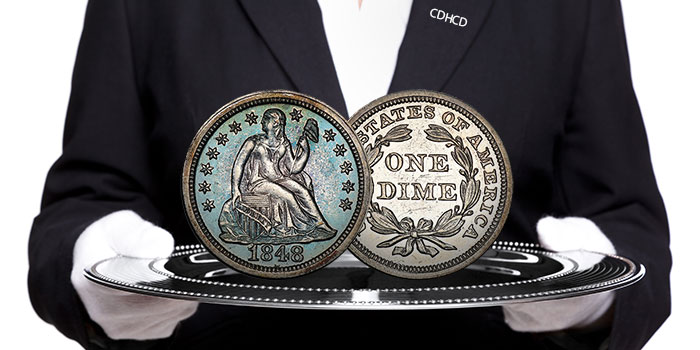
CoinWeek Editor Charles Morgan talks to a coin dealer who discovered one of the eight-known 1848 Liberty Seated Dime Proofs on eBay.
Graders at NGC write about a fake 1842-O Liberty Seated Dime they encountered in a customer’s submission.
Greg Reynolds on the Stars and Drapery Dime
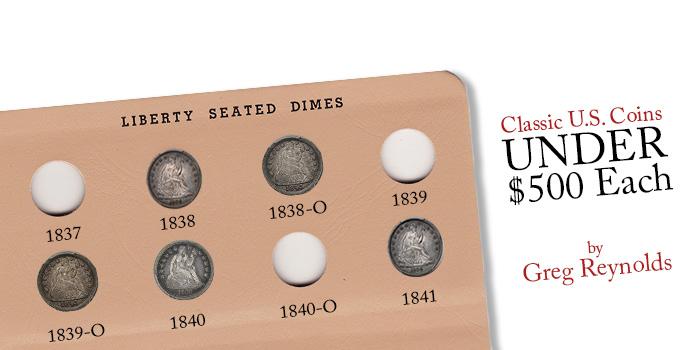
- Classic U.S. Coins for Less Than $500 Each, Part 32: Liberty Seated Dimes 1838-60
- Classic U.S. Coins: The Rarity of 1843-O Liberty Seated Dimes
- Coin Rarities & Related Topics: 1796 Quarter, San Francisco Liberty Seated Dimes, 1931 Denver Mint $20 Gold Coin
CoinWeek contributor Greg Reynolds discusses the type in his long-running columns on classic U.S. coins.
Design
A full-length representation of Liberty wears long, flowing robes and is seated on a rock, head turned back to her right. Her left arm is bent and holds a pole topped by a Liberty cap. The right arm extends down at her side, hand supporting a Union shield with a curved banner displaying the word LIBERTY. The date is centered at the bottom, below the rock upon which Liberty rests. Inside denticles along the raised rim, 13 stars form a partial circle: seven to the left of Liberty, one between Liberty’s head and the Liberty cap, and five to the right.
The reverse has a concentric circle formed by the legend UNITED STATES OF AMERICA inside the denticulated rim, broken at the bottom by the ribbon that ties the ends of two branches. The branches form another circle inside the text, though the ends are slightly separated at the top, and in the center is the denomination of ONE DIME, each word on a separate line. Drapery dimes were produced in Philadelphia, New Orleans, and San Francisco; the O and S mintmarks are located below DIME and above the bow at the top of the ribbon.
Varieties
Many varieties are known, including the 1841 No Drapery (a result of excessive die reworking); the 1853 No Arrows; the 1856 Large Date and Small Date; the 1859 Obverse of 1859 With Stars, Reverse of 1860 (a transitional pattern that does not display UNITED STATES OF AMERICA on either coin side); plus other, more minor die variations.
Coin Specifications
| Liberty Seated Dime, Stars and Drapery | |
| Years of Issue: | 1840-60 |
| Mintage (Circulation): | High: 5,780,000 (1856); Low: 31,300 (1846) |
| Mintage (Proof): | High: 800 (1859); Low: 5 (1841, estimated) |
| Alloy: | .900 silver and .100 copper |
| Weight: | 2.67 g (1840-1853); 2.49 g (1853-1860) |
| Diameter: | 17.90 mm |
| Edge: | Reeded |
| OBV Designer: | Robert Ball Hughes (after Christian Gobrecht), from sketches by Titian Peale/Thomas Sully |
| REV Designer: | Christian Gobrecht |
* * *
Additional References
Bowers, Q. David. The Experts Guide to Collecting and Investing in Rare Coins. Whitman Publishing.
–. A Guide Book of United States Type Coins. Whitman Publishing.
Breen, Walter. Walter Breen’s Encyclopedia of U.S. Coins. Doubleday.
Guth, Ron, and Jeff Garrett. United States Coinage: A Study by Type. Whitman Publishing.
Taxay, Don. The U.S. Mint and Coinage. Arco Publishing.
Yeoman, R.S., and Jeff Garrett (editor). The Official Red Book: A Guide Book of United States Coins. Whitman Publishing.
* * *