By Charles Morgan and Hubert Walker for CoinWeek Notes …..
The Mint Act of 1890 allowed for the changing of coin designs every 25 years, and the dime, quarter, and half dollar were eligible in 1891. An initial competition to produce new designs was opened to 10 eminent U.S. sculptors, but when those invited presented a list of requirements that included compensation for every entry whether selected or not, the Treasury Department demurred. The contest was instead opened to the general public; judges included United States Mint Chief Engraver Charles E. Barber, Boston engraver Henry Mitchell, and artist Augustus Saint-Gaudens. None of the entries were deemed satisfactory, with two of about 300 entries awarded only an Honorable Mention. Mint Director Edward Leech deemed the competition a “wretched failure,” and assigned Barber the task of redesigning the coins.
Barber’s Liberty is said to be modeled after Assistant Engraver George T. Morgan’s silver dollar portrait. However, the similarities likely will not be obvious to the casual observer. In contrast to the Morgan Dollar, Barber faced his Liberty to the right, shortened and covered most of her hair, and minimized the headband that displayed LIBERTY, instead placing a laurel wreath around the base of the cap. If it’s a copy of the Morgan design, then it’s an inferior one.
Barber also replaced the naturalistic eagle used on the reverse of the Liberty Seated Half Dollar with one reminiscent of Chief Engraver Robert Scot’s Heraldic eagle used on the Draped Bust Half Dollar of the early 1800s.
Barber Dimes, Barber Quarters, and half dollars are some of the few coin types to be commonly referred to by the name of the designer (Gobrecht Dollars, the Morgan type, and Saint-Gaudens Double Eagles being others), but this type is also known as the Liberty Head. Barber Half Dollars were produced for 24 years, a design that both started and ended according to the terms of the 1890 Mint Act.
How Much Are Barber Half Dollars Worth?
For most years of issue, the combined population of CAC-, NGC-, and PCGS-certified Barber Half Dollars exceeds 1,000 pieces. Many of these are circulated coins graded Extra Fine or better. Mint State coins typically number a few hundred, mostly in the MS63 to MS64 range. Gem Barber Half Dollars are surprisingly difficult to acquire for most dates and are undervalued relative to their scarcity.
The Philadelphia issues are the most affordable coins in the series, with New Orleans and San Francisco issues being scarcer. The later mint-marked issues are more common, however.
The 1892-O Micro O variety is the most infrequently seen issue in the series, with fewer than 100 pieces certified as of July 2024.
Several thousand Proof Barber Half Dollars have been certified, including many Cameo and Deep Cameo/Ultra Cameo pieces. Prices are moderate to Select Proof, expensive from PR64 through PR66, and very expensive finer than that. Prices of Proof Barber halves are uniform from date to date, with Cameo and Deep Cameo/Ultra Cameo examples listed at higher prices, particularly as Gem and finer.
CoinWeek Exclusive Coverage of the Barber Half Dollar
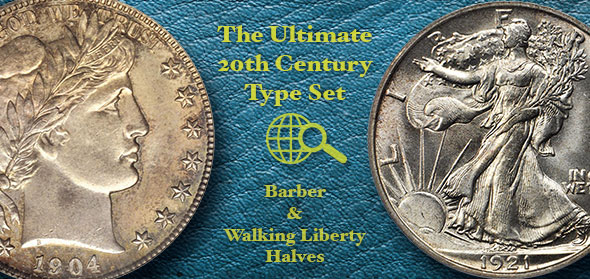
CoinWeek’s Charles Morgan and Hubert Walker help collectors build the Ultimate 20th-Century Type Set of Barber Half Dollars.
Coin dealer Thomas Bush of Thomas Bush Numismatics offers the reader his advice on collecting Barber halves gleaned from 20 years of experience/
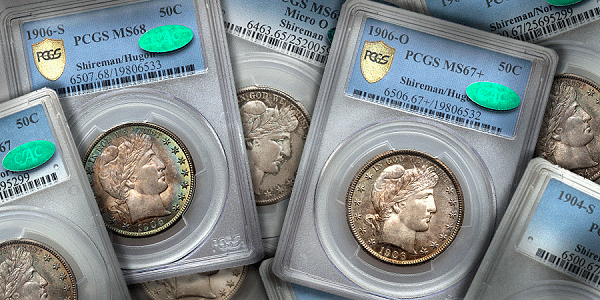
- Classic US Coins for Less Than $500 Each, Part 6: Barber Half Dollars
- Building a Set of Almost Uncirculated-55 to ‘Mint State’-63 Barber Half Dollars
- Shireman Set of Gem Barber Half Dollars to Be Auctioned
CoinWeek contributor and classic U.S. coin specialist Greg Reynolds offers advice on collecting the series regardless of budget. Each article is packed with useful information garnered from a lifetime of study and viewing rare coins in person.
- Coin Rarities and Related Topics: Denver Mint Barber Half Dollars of 1907
- Coin Rarities & Related Topics: Philadelphia Mint Barber Half Dollars of 1904
In his Coin Rarities and Related Topics column, Greg goes in-depth on Barber halves from the Denver and Philadelphia mints.
In-Depth Barber Half Dollar Date Analysis
Design
Obverse:
Liberty faces right, with tightly constrained hair barely visible below a prominent wreath of laurel that surrounds the base of a hat; the wreath is tied at the back by a ribbon. Above the forehead is a small band that displays the word LIBERTY. Inside the denticulated rim is the motto IN GOD WE TRUST at the top, the date at the bottom, and completing the circle, six-pointed stars connecting the phrases: six stars to the left of Liberty and seven to the right. The designer’s initial B is toward the back of the base of the neck.
Reverse:
The reverse displays a somewhat awkwardly proportioned eagle with outstretched wings and legs, the dexter claw (viewer’s left) clutching an olive branch and the sinister a bundle of 13 arrows. The eagle holds in its beak a flowing ribbon displaying the motto E PLURIBUS UNUM, and a Union shield is across the chest. The rim is denticulated and around the periphery of the surface are the legend UNITED STATES OF AMERICA at the top (overlapped by the tips of the eagle’s wings) and the denomination HALF DOLLAR at the bottom, the phrases separated by two centered dots. Thirteen five-pointed stars fill the field above the eagle below STATES OF. Half dollars were minted at Philadelphia, New Orleans, San Francisco, and Denver; O, S, and D mintmarks are below the eagle and above the DO in DOLLAR.
Edge:
The edge of the Barber Half Dollar is reeded.
Varieties
Several varieties from the Barber Half Dollar series are known, most being minor die variations. The 1892-O Micro O mentioned above is the best known, showing a smaller than normal “O” mintmark, presumably from a punch designed for the quarter rather than the half dollar.
Coin Specifications
| Barber Half Dollar | |
| Years of Issue: | 1892-1915 |
| Mintage (Circulation): | High: 5,538,000 (1899); Low: 124,230 (1914) |
| Mintage (Proof): | High: 1,245 (1892); Low: 380 (1914) |
| Alloy: | .900 silver and .100 copper |
| Weight: | 12.5 g |
| Diameter: | 30.6 mm |
| Edge: | Reeded |
| OBV Designer: | Charles E. Barber |
| REV Designer: | Charles E. Barber |
* * *
Additional References
Bowers, Q. David. The Experts Guide to Collecting & Investing in Rare Coins. Whitman Publishing.
–. A Guide Book of United States Type Coins. Whitman Publishing.
–. A Guide Book of Barber Silver Coins. Whitman Publishing.
Breen, Walter. Walter Breen’s Encyclopedia of U.S. Coins. Doubleday.
Feigenbaum, David Lawrence. The Complete Guide to Barber Halves. DLRC Press.
Feigenbaum, David Lawrence and John Feigenbaum. The Complete Guide to Certified Barber Coinage. DLRC Press.
Flynn, Kevin. The Authoritative Reference on Barber Half Dollars. Brooklyn Gallery.
Guth, Ron, and Jeff Garrett. United States Coinage: A Study by Type. Whitman Publishing.
Taxay, Don. The U.S. Mint and Coinage. Arco Publishing.
Yeoman, R.S., and Jeff Garrett (editor). The Official Red Book: A Guide Book of United States Coins. Whitman Publishing.
* * *