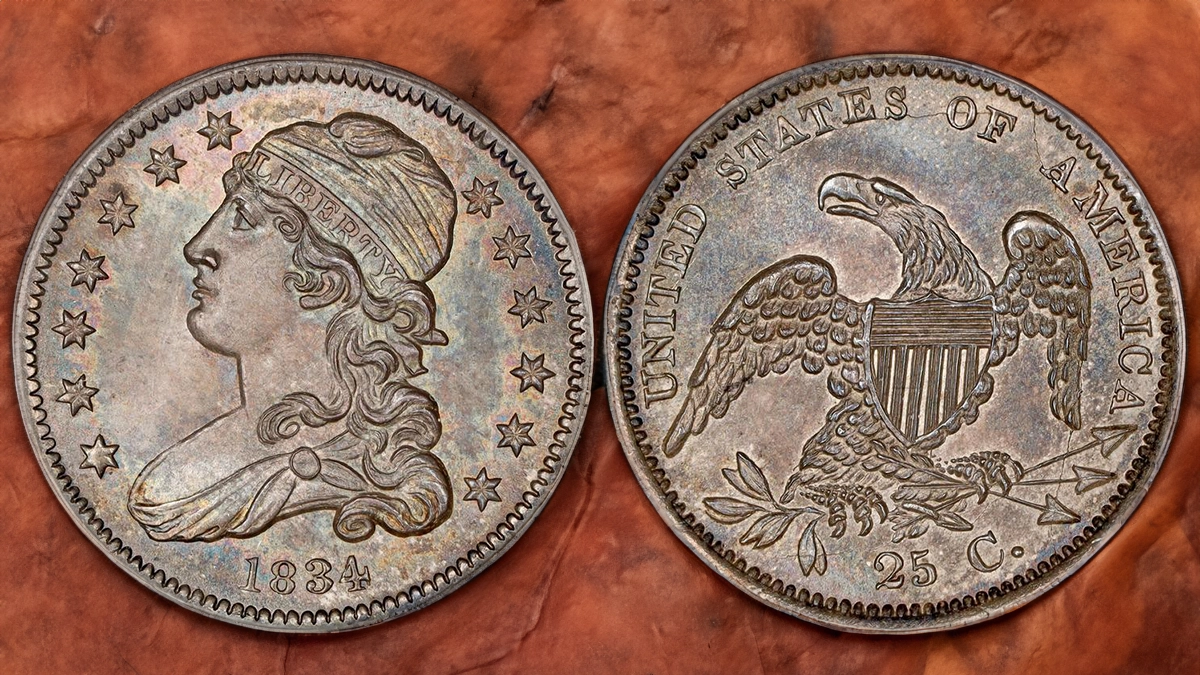
By Charles Morgan and Hubert Walker for CoinWeek Notes …..
Quarters with engraver John Reich’s Capped Bust design, introduced in 1815, were not struck in 1829 and 1830. When quarter production resumed in 1831, it was with new technology: the “close collar“, a die that surrounded the edge of the planchet during striking. This collar die prevented the planchet from spreading outward, giving uniformity to the finished coins while at the same time impressing a reeded pattern into the coin’s edge. A second technical improvement resulting from the close collar was a raised rim to protect interior design elements from wear.
United States Mint Chief Engraver William Kneass modified Reich’s design to adapt it to the new requirements. He kept the overall look of the Capped Bust Quarter but made changes that improved strike quality and, in the minds of some, refined the appearance of Liberty’s portrait.
A more controversial change was the removal of the motto E PLURIBUS UNUM (“One Made up of Many”), which Mint Director Samuel Moore viewed as redundant considering the legend UNITED STATES OF AMERICA was on the reverse. Moore was compelled to go to Washington to justify his decision to Treasury Department officials who wanted the motto restored. Moore was successful in his efforts, and the motto was absent from the quarter for 60 years until reintroduced by Charles Barber on his 1892 quarter design.
Unlike the Large Diameter Capped Bust type, Reduced Diameter quarters were produced yearly through the end of the series in 1838.
How Much Are Small Diameter Capped Bust Quarters Worth?
Prices for business strikes are moderate up to XF grades, advancing steadily and becoming expensive as Gem and finer. Though some dates are more common in census/population reports, prices for all dates are fairly uniform, with small differences apparent only for coins graded Gem and finer. A few Prooflike business strikes have been certified.
Census/population reports list only a small number of Proofs from each year and include pieces with a Cameo designation. All Proofs are expensive to extremely expensive, particularly as Gem and finer. Proofs for 1831 have been certified only for the Large Letters variety. The 1833 and 1838 Proof issues show steadily increasing price premiums over the other dates, with prices for the 1833 as near-Gem nearly double that of lesser-quality coins.
Capped Bust Quarter, Small Diameter In-Depth Date Analysis by CoinWeek Notes
Design
Obverse:
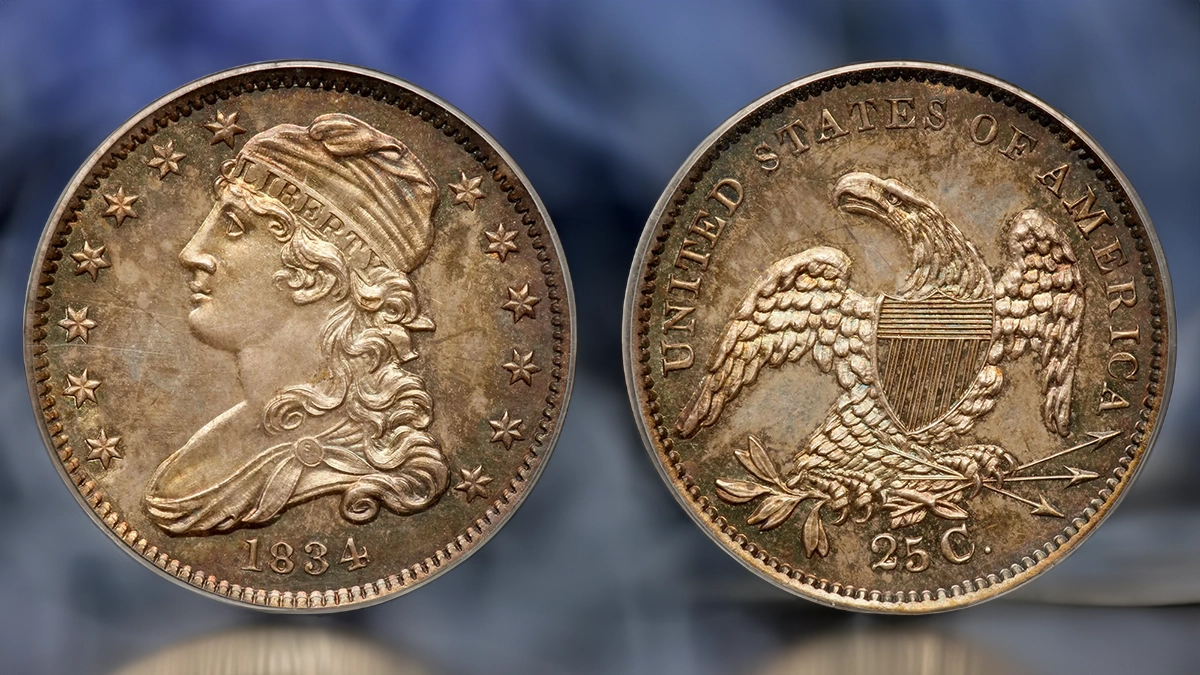
The obverse portrait of Liberty is a leaner, perhaps more elegant representation than the previous Capped Bust version. Liberty is wearing a mobcap (a fashionable woman’s headdress of the period, not a liberty cap as it is sometimes erroneously labeled) with a band displaying the word LIBERTY. Long curling hair drapes over the forehead, around the ear, across the shoulders, and down the back. A flowing robe, which covers the bust and shoulder, is fixed with a clasp above the shoulder. Thirteen six-pointed stars surround the portrait: seven to the left and six to the right. Surrounding the design is a denticulated or beaded border inside the raised rim. The date is centered at the bottom.
Reverse:
The reverse displays a left-facing eagle with outstretched (though partially folded) wings and a Union shield across its breast. The sinister claw (viewer’s right) clutches three arrows and the dexter claw (viewer’s left) holds an olive branch. The legend UNITED STATES OF AMERICA encircles the top two-thirds of the coin inside the denticulated border and outer rim, and the denomination 25 C. is below the eagle at the bottom. The period after C is absent on some date varieties. All coins were minted at Philadelphia, hence no mintmark appears.
Edge:
The edge of the Small Diameter Capped Bust Quarter is reeded.
Varieties
A few minor variations in the appearance, size, and placement of device details have been identified. Best-known varieties include 1831 Small Letter and Large Letter types (referring to the size of the reverse UNITED STATES OF AMERICA lettering), and 1833-1835 examples with no period after the denomination.
Coin Specifications
| Capped Bust Quarter, Small Diameter | |
| Years of Issue: | 1831-38 |
| Mintage (Circulation): | High: 1,952,000 (1835); Low: 156,000 (1833) |
| Mintage (Proof): | High: 20 (1831, estimated); Low: 5 (1838, estimated) |
| Alloy: | .8924 silver, .1076 copper; .900 silver, .100 copper in 1837 and 1838 |
| Weight: | 6.74 g (1831-1836); 6.68 g (1837-1838) |
| Diameter: | ±24.30 mm |
| Edge: | Reeded |
| OBV Designer: | John Reich, modified by William Kneass |
| REV Designer: | Christian Gobrecht |
* * *
Additional References
Bowers, Q. David. The Experts Guide to Collecting and Investing in Rare Coins. Whitman Publishing.
–. A Guide Book of United States Type Coins. Whitman Publishing.
Breen, Walter. Walter Breen’s Encyclopedia of U.S. Coins. Doubleday.
Guth, Ron, and Jeff Garrett. United States Coinage: A Study by Type. Whitman Publishing.
Taxay, Don. The U.S. Mint and Coinage. Arco Publishing.
Tompkins, Steve. Early United States Quarters, 1796-1838. Steve Tompkins and Destini, Inc.
Yeoman, R.S., and Jeff Garrett (editor). The Official Red Book: A Guide Book of United States Coins. Whitman Publishing.
* * *