


By Charles Morgan and Hubert Walker for CoinWeek Notes …..
The growth of fractional coins in the United States reached record levels in 1967, with more than 7.2 billion pieces struck. The Lincoln Memorial Cent led the way, accounting for 42% of the year’s coinage. The 1967 Washington Quarter’s 1.52 billion coin emission was more than twice the highest mintage of any issue from the 90% silver period but not nearly enough to surpass the 1965 issue with its 1.8 billion coins.
| 1967 Coin Mintages | |||
| Cent | 3,048,667,100 | Nickel | 107,325,800 |
| Dime | 2,244,007,320 | Quarter | 1,524,031,848 |
| Half Dollar | 295,046,978 | Total: 7,219,079,046 | |
Of course, these gargantuan mintages were not accomplished without consolidating the total output from three facilities: 873,524,000 were struck at Philadelphia, 632,767,848 at Denver, and 17,740,000 at San Francisco. None carry a mintmark; to date, none of the grading services have certified examples where the quarter’s mint source is identifiable.
Although not frequently encountered in change today, the 1967 Washington Quarter and the 1965 were routinely found in change as recently as the mid-to-late 1980s. By this point, the typical circulated example graded VF-XF, with the finer details worn down if not flat. Coins in this condition generally have no numismatic value.
Much more interesting to coin collectors are 1967 Washington Quarters in Mint State. Mint State examples of this date were saved in quantity, but probably not to the level that would have been preserved had the United States Mint produced Uncirculated Coin Sets. By comparison, in 1964, the Mint sold over one million of these sets, while in 1968, when the annual Uncirculated Set program resumed, demand exceeded 2.1 million. We find it highly unlikely that such quantities of uncirculated coins were saved from the 1967 issue. That being said, the 1967 Washington Quarter in Mint State is not rare and a reasonable price to pay for an example is about $5, unless the coin has been certified as a Gem or better by CAC, NGC, or PCGS.
Confusing matters is the fact that the United States Mint produced quasi-Proof coins for Special Mint Sets. 1,863,344 of these sets were produced in 1967, and to the untrained eye, Special Mint Set coins can be mistaken for business strikes. What differentiates the two is the glassy quality of the surfaces of the Special Mint Set coin. By contrast, the business strike 1967 Washington Quarter will exhibit frosty or satiny surfaces with naked-eye visible luster in Mint State. Grading services will differentiate between the two, but not all sellers will note the distinction.
How Much Is the 1967 Washington Quarter Worth?
The current top population grade at PCGS is MS68, while NGC has certified one coin at the MS69 level. NGC certified the MS69 coin in the summer of 2024; previously, NGC reported two coins at its highest grade of MS68+. We have not had a chance to review those coins or locate photographs of them, but, with the addition of the MS69, the pop at MS68+ has fallen to just one. Was the MS69 an upgrade? We do not know.
What we do know, is that the NGC MS69 sold for $8,156.25 at its first public auction appearance in August 2024. A close inspection of the high quality scans and coin photography provided by GreatCollections reveals that this coin is, without a doubt, one of the finest pre-1983 clad-era quarters that we’ve ever seen and we feel that it should cross if submitted to CAC or PCGS.
As for PCGS MS68 price performance, we note a significant decline in auction prices for a PCGS MS68 coin (#81970592). This coin sold in 2017 for $8,812.50, but hammered for only $4,800 two years later.
MS67+ and MS67 coins have also seen steep declines. In 2007-2008, PCGS MS67 examples routinely sold at auction for $275-$350. In 2023, Stack’s Bowers sold two examples for $80 each. In September 2016, a PCGS MS67+ example sold for $5,170. A year later, another example brought just $517.
MS67 is the optimum grade for quality-minded collectors. Still, we wonder if it wouldn’t be advisable to seek out high-quality coins from rolls and submit the best ones instead of paying high dollars for a ready-made condition rarity, especially as the pops are bound to continue to increase until there is no money to be made in doing so.
Another word of caution: as of May 2024, we have observed a recent rash of high-dollar transactions on eBay of run-of-the-mill worn 1967 Washington Quarters, where the seller claims the coins are rare or contain multiple errors. Based on our observations, nothing in the listings or the available literature on the series substantiates these claims or supports the seller’s prices. We advise anybody interested in varieties or mint errors to check out the CONECA Master List before considering any purchase.
* * *
Market Data and Noteworthy Specimens
Top Population: PCGS MS68 (3, 5/2025), NGC MS69 (1, 5/2025), and CAC MS66+ (1, 5/2025).
- NGC MS69 #6969800-001: GreatCollections, August 11, 2024, Lot 1615571 – $8,156.25. Top pop, pop one when offered. Practically flawless. Brilliant.
- NGC MS68 #6208616-006: GreatCollections, February 26, 2023, Lot 1000454 –View; Heritage Auctions, September 15, 2023, Lot 3286 – $1,500; Heritage Auctions, June 16, 2024, Lot 7074 – $1,140. Brilliant.
- PCGS MS68 #46718444: Heritage Auctions, August 12, 2024, Lot 3323 – $3,960.
- PCGS MS68 #81970592: Heritage Auctions, January 5, 2017, Lot 4802 – $8,812.50. “Charlie O’s Collection,” Heritage Auctions, June 6, 2019, Lot 3099 – $5,040; Heritage Auctions, January 9, 2020, Lot 3717 – $4,800. This piece has attractive toning with cobalt edges and golden interiors.
- NGC MS68 #3735224-004: Heritage Auctions, August 2, 2017, Lot 3708 – $4,465.
- PCGS MS67+ #81480823: GreatCollections, August 7, 2016, Lot 381483 – View; Heritage Auctions, March 14, 2018, Lot 23576 – $600.
- PCGS MS67+ #81480824: Heritage Auctions, April 30, 2017, Lot 7538 – $493.50.
- PCGS MS67+ #82658870: Heritage Auctions, February 16, 2017, Lot 3581 – $517; GreatCollections, February 18, 2018, Lot 533245 – View.
- PCGS MS67+ #81480824: Heritage Auctions, September 11, 2016, Lot 7596 – $5,170.
- PCGS MS67 #49298007: eBay, April 24, 2024 – $179. Flashy and lustrous.
- NGC MS67 #6808490-024: eBay, April 11, 2024 – $17.99.
- NGC MS67 #6799888-004: eBay, February 26, 2024 – $95.
1967 Washington Quarter, Struck on a 90% Silver Planchet
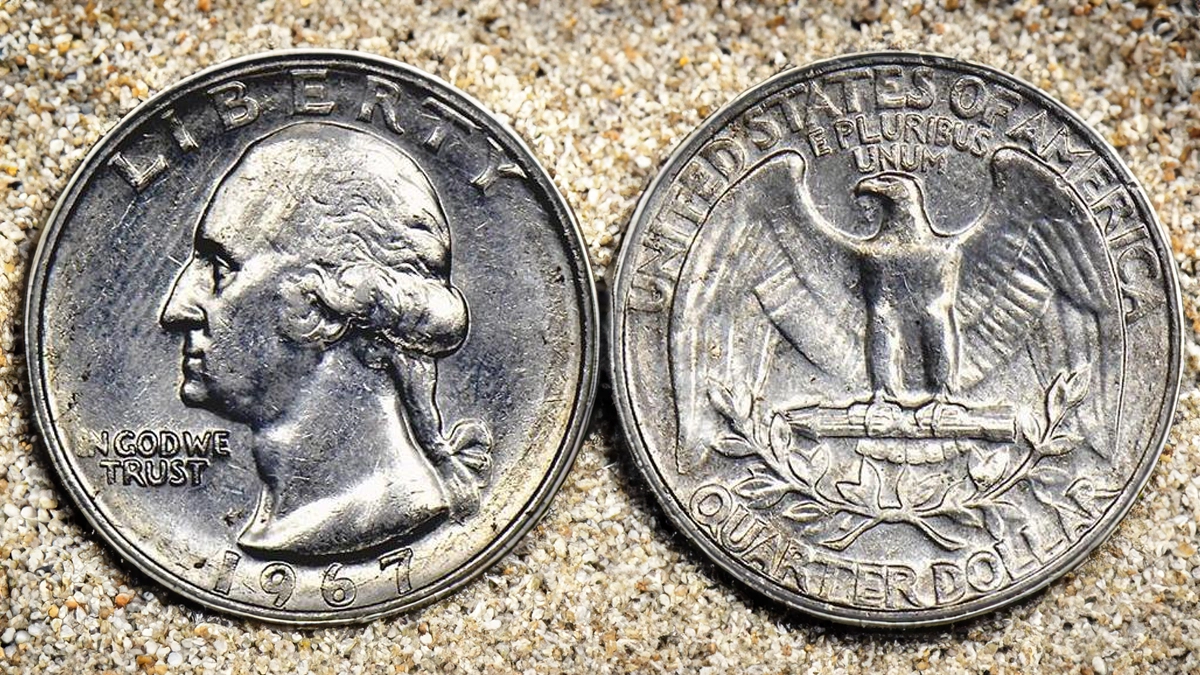
- ANACS AU58 Details (Cleaned): “The Eldorado Sale,” Stack’s Bowers, May 14, 2009, Lot 391 – $5,750.
* * *
Design
Obverse:
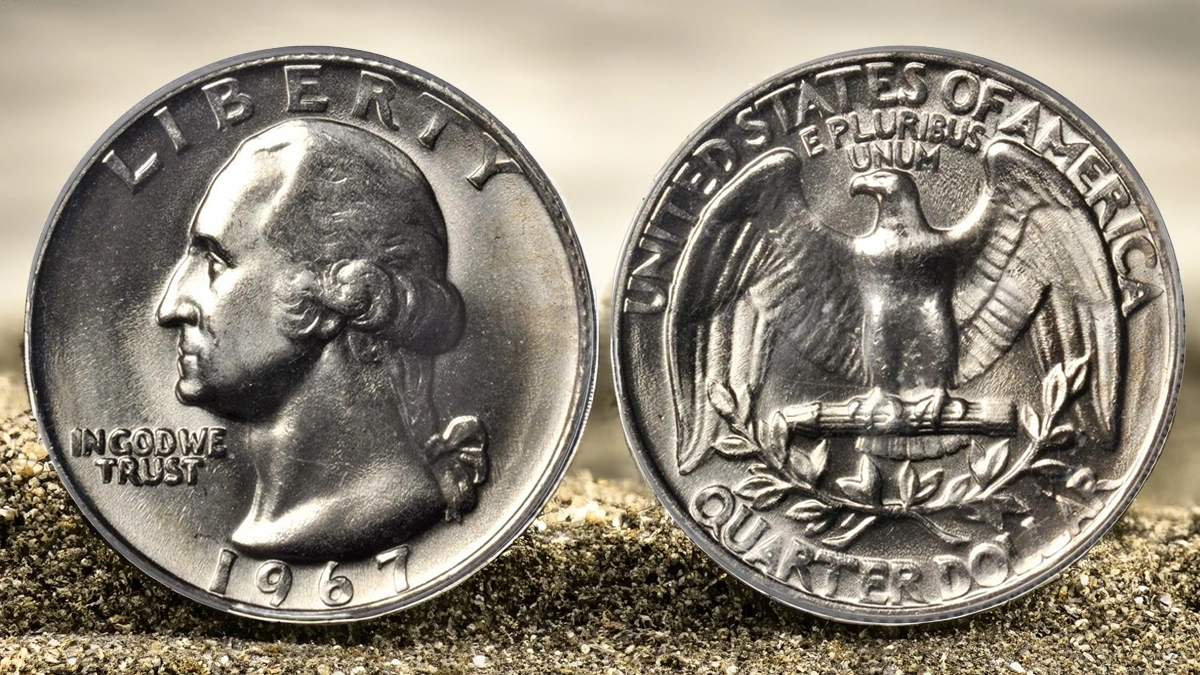
Designed by sculptor John Flanagan, the obverse of the 1965 Washington Quarter is based on a bust of the general created by the neoclassical French sculptor Jean-Antoine Houdon in 1785. However, Flanagan’s design differs from the original bust in several ways, such as a slightly different head shape and several curls of hair that are not on the bust; for comparison, the bust can be viewed at the late president’s Virginia estate, Mount Vernon. Under the left-facing bust’s chin is the motto IN GOD WE TRUST. The legend LIBERTY runs along the top of the coin’s field, and the date 1967 is below. In small letters, Flanagan’s initials JF can be found above the “7” in 1967 at the base of the bust.
Reverse:
Unlike the obverse, no restrictions were placed on the candidate sculptors when designing the Washington Quarter reverse. Flanagan’s reverse is dominated by a heraldic eagle with outstretched wings and a left-facing head. The eagle is perched on a neat bundle of arrows with two intertwined olive branches below. The two main inscriptions above the eagle are UNITED STATES OF AMERICA and E PLURIBUS UNUM. Finally, at six o’clock on the design is the denomination written out as QUARTER DOLLAR.
Edge:
The edge of the 1965 Washington quarter is reeded. As struck, the top and bottom edges will appear grey, while the center will appear copper colored.
Designer
John Flanagan was born in New Jersey in 1865 and lived in New York for most of his life. He began working with Augustus Saint-Gaudens in 1884 and quickly became a well-known sculptor and medallic artist in his own right. Saint-Gaudens made introductions for Flanagan at the United States Mint. While the Washington Quarter was his sole coin design, Flanagan designed numerous famous medals and sculptures, including the official medal of the 1915 Panama-Pacific International Exposition, the official Verdun medal gifted to France by the United States, and the 1924 bust of Saint-Gaudens. Flanagan was also a member of the American Numismatic Society (ANS).
Coin Specifications
| Country: | United States of America |
| Year of Issue: | 1967 |
| Denomination: | Quarter Dollar (25 Cents USD) |
| Mintmark: | None (Philadelphia and Denver) |
| Mintage: | 1,819,717,540 |
| Alloy: | Outer layers of copper-nickel (.750 copper and .250 nickel) bonded to a pure copper inner core. |
| Weight: | 5.67 g |
| Diameter: | 24.30 mm |
| Edge: | Reeded |
| OBV Designer: | John Flanagan |
| REV Designer: | John Flanagan |
| Quality: | Business Strike |
* * *



Really involved in numismatics ! Really love finding something different than the norm…..
I Have a 1967 Washington quarter, does that mean that that it is copper or silver?
@Richard Edmundson As the article notes, the normal composition for 1965 and later circulating quarters is cupronickel cladding over a pure copper core. The only such coins struck in silver were made in error and are VERY rare.
While it’s extremely unlikely to find one accidentally struck in 90% silver, the easiest way to tell them apart is to look at the coins’ edges. Cupronickel-clad coins will show the brown band found on all current business-strike dimes, quarters, and halves. 90% silver coins will show a uniform silver edge, while any 40% silver coins that may have been mistakenly spent will show light-silver bands on the outer sides of the edge with a grayish band in between.
I have two of the 1967 Quarter Dollar
Where’s can you sell old coins
I have 130 1967 quarters I save them because it’s my birth year. I also have way to many 1965 1982/83 and bicentennials. I’ve just been collecting them for yrs figured pass on to my kids hey one day that money may help them who knows
I have a bicentennial quarter 1967 . Who do I get to look at it
@Lisa May If the date is 1967 it wouldn’t be a Bicentennial quarter. They all carry the dual date 1776-1976 and have Jack Ahr’s drummer-boy image on the reverse side. Either way, circulating versions of both coins were made in huge numbers and aren’t rare. Unless the coins are uncirculated or special collectors’ versions, they’re still only worth face value.
I got many coins where can i certificate
The three major grading services are CAC, NGC, and PCGS. Visit their websites to determine if it’s worth it to certify your coins:
CAC – http://www.cacgrading.com
NGC – http://www.ngccoin.com
PCGS – http://www.pcgs.com
I have the exact quarter ur talking about and would love to see how much I can get for it?
@Valerie K Schook If you re-check the article, prices for 1967 quarters are explained in detail. Because there were over 1.5 billion business strikes any that are found in circulated condition will only be worth face value.
I’m curious to know if I should do anything with my quarters I have 1965 through 1969 I’m really looking to sell shortly here. I just don’t know if I should get them graded or just sell them?
@Lisa Roque: Did you look at any of the coin-values sites (NOT eBay btw) that were mentioned in the article? Massive numbers of business-strike quarters were made during those years. Any that were saved from change are unlikely to carry a premium. You’d need to look for uncirculated specimens (any date), SMS versions (1965-67), or proof issues (1968-69). Also remember that regardless of internet mythology, quarters from that time that don’t carry mint marks are NOT errors: All coins from 1965-67 are “plain”, and any from other dates up to 1979 without mint marks were made in Philadelphia.
I have one but I don’t know where I sell it
@Ali: As the article explains, unless your coin is in top uncirculated condition it’s only worth face value.
I have a 1967 quarter
This was a fascinating read! I had no idea about the historical context behind the 1967 Washington Quarter. The insights on its value really helped me understand what to look for in my own collection. Thanks for sharing!