By Charles Morgan and Hubert Walker for CoinWeek Notes …..
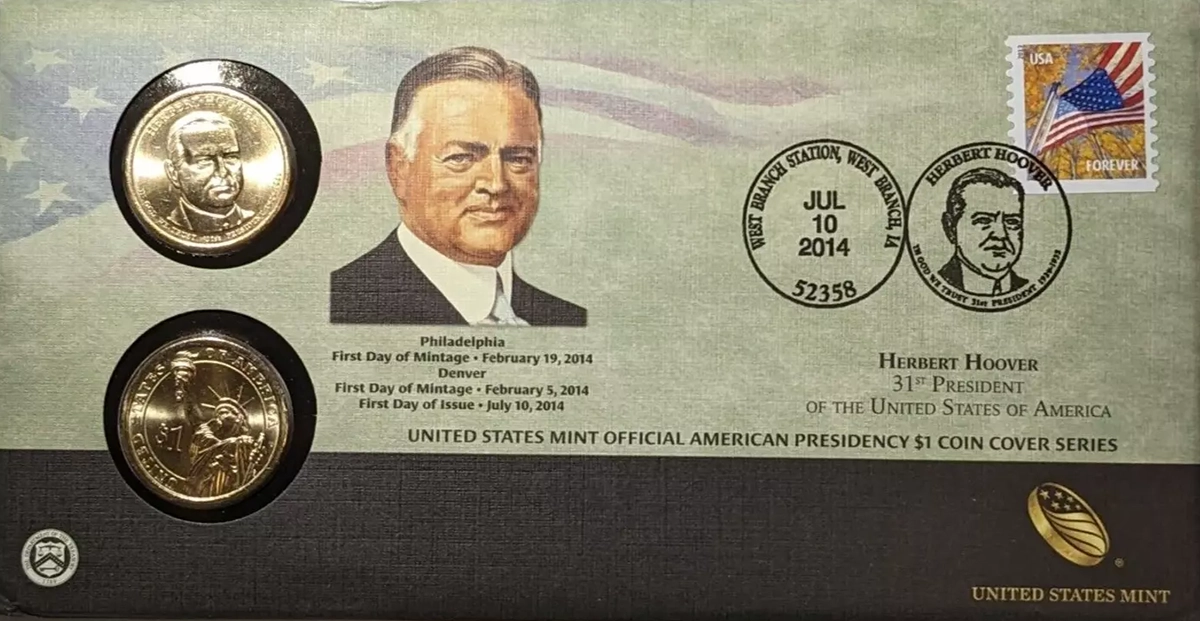
The 2014-P Herbert Hoover Presidential Dollar is the Philadelphia striking of the Presidential Dollar coin honoring the nation’s 31st President, Republican Herbert Hoover. The coin’s entire mintage of 4,480,000 was struck for sale through the United States Mint’s numismatic store; none were released into circulation as the Treasury Department had abandoned that part of the Presidential Dollar Coin Program in late 2011.
Herbert Hoover’s Life and Legacy
In the course of its mandate, the Presidential Dollar series has honored several U.S. presidents with less-than-stellar historical reputations. Herbert Hoover, the nation’s 31st President, has long been placed in the pantheon of worst U.S. Presidents due to his handing of the United States economy in the aftermath of the stock market crash of October 1929. It was Hoover who coined the phrase “depression” to describe the unfolding economic panic and it was Hoover who is stuck with the blame for the Federal Government’s anemic response to the Great Depression.
The real Hoover was a much more complex man than the caricature portrays. Born August 10, 1874, in West Branch, Iowa to a modest Quaker family, Hoover was orphaned at the age of nine. Sent to Oregon to live with his uncle’s family, the unconditional love Hoover once felt from his parents was replaced by strict rules and work. Hoover eventually enrolled in the first class at Stanford University and studied geology. He entered the mining business, overseeing gold operations in Australia and China. In his early 30s, Hoover retired to London, a wealthy man.
As World War I broke out, Hoover’s philanthropy became known worldwide. He spearheaded an effort to get Americans out Europe and led a massive relief effort to feed starving Belgians, whose ports were cut off due to the war. Due the success of Hoover’s Belgian initiative, President Woodrow Wilson nominated Hoover to serve as the Director of the U.S. Food Administration, a newly established position. In this capacity, Hoover galvanized the American people to donate food to the European Allied Powers, while working with domestic producers to standardize packaging and stabilize pricing.
In 1921, President Calvin Coolidge nominated Hoover to serve as the Secretary of Commerce, a position he held throughout the period of explosive economic expansion known as the “Roaring Twenties”. In 1927, a massive flood along the Mississippi River impacted more than a million Americans. The governors of the impacted region urged Coolidge to put Hoover in charge of a federal response. Such a move went against the Republican governing orthodoxy, which saw this a problem to be solved by the states and local businesses and charities. This ideology would come back to bite Hoover during his Presidency. Eventually, Coolidge relented and tasked the Commerce Secretary with spearheading the relief effort. Hoover oversaw the temporary relocation of more than 1.5 million Americans and trucked in massive amounts of relief.
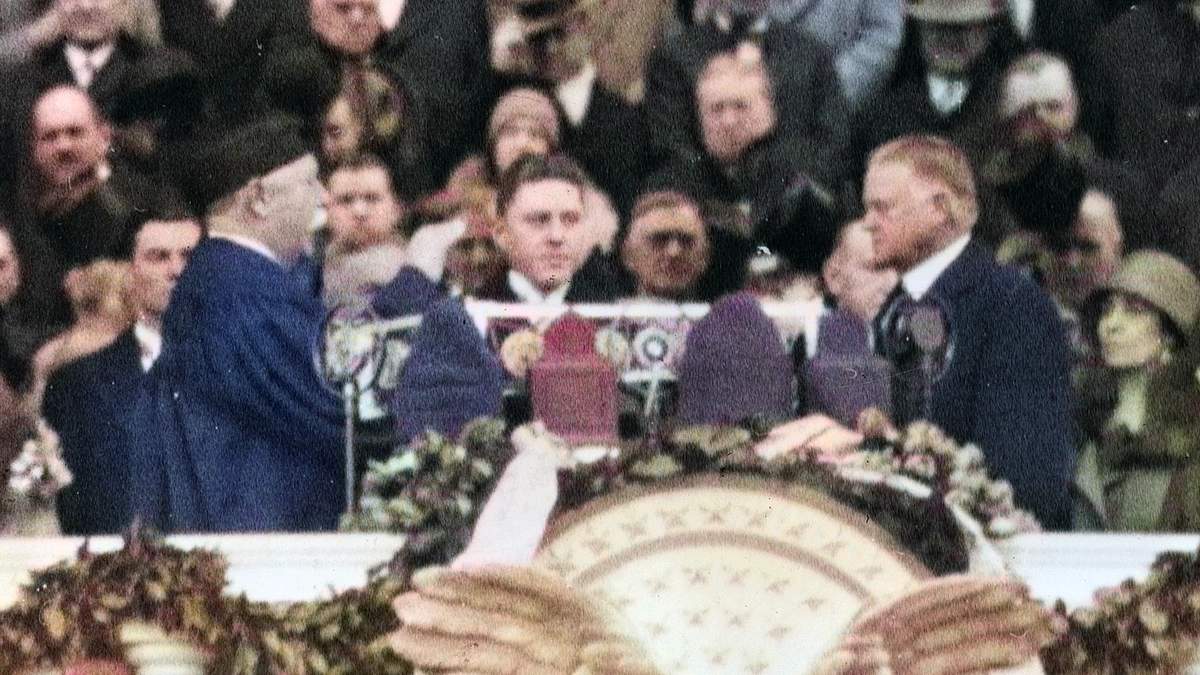
When Coolidge decided not to run for President, Hoover was the logical choice to win the Republican nomination. In the election of 1928, Hoover roundly defeated Democrat Governor Al Smith of New York, securing 444 electoral votes in the process.
At the outset of his Presidency, Hoover was optimistic about the country’s future and wanted to foster a more efficient marketplace that would be good for companies and consumers. This pro-business approach was reinforced by the same scientific methodology that made him a successful engineer, turning around failing gold mines. Unfortunately, cracks in the economic structure of the developed western nations could not be papered over by blue ribbon committees and the standardization of milk container sizes. When the stock market crashed in the United States, its impact was felt throughout Europe – especially Germany, which was heavily reliant on American loans. The Nazis seized the opportunity to lead Germany out of its economic ruin and seek revenge on those who made it weak in the aftermath of Versailles. Fascism spread throughout Eastern and Central Europe and the Japanese Empire sought to expand its influence across Asia and the Pacific.
In the United States, Hoover’s policies were focused on shoring up the business and farming sectors and did little to ease the suffering of the unemployed. Tent cities popped up around the country, which became known as “Hoovervilles”. By 1932, nearly one-quarter of Americans were out of work. Hoover also inherited the disastrous 18th Amendment, which banned the consumption of alcohol, leading to a surge in organized criminal activity and unpopular prosecutions.
In the election of 1932, Hoover carried only six states as the Republicans were swept out of office by Franklin Delano Roosevelt and the “New Deal” Democrats.
The Roosevelt Administration carried the country through the Great Depression and to the end of World War II, a war which was brought about in no small part by the global economic crisis. Roosevelt’s many initiatives were necessary and transformational for the American system and probably spared the country from more radical political upheaval. Hoover, a hero to most Americans in the lead-up to his presidency, suffered irreparable damage to his reputation as a result of the choices he made while in office. Hoover was sharply critical of Roosevelt’s economic policies, which he saw as socialist, and was even critical of the Administration’s handling of World War II.
Hoover returned to government service during the administration of President Harry Truman. Despite their ideological differences, Hoover worked to reduce government waste during the rebuilding of Europe under U.S. occupation. He also served under President Dwight D. Eisenhower, even though Hoover was critical of Ike’s reluctance to roll back the New Deal.
Hoover died on October 20, 1964.
Launch Ceremony
The 2014-P Herbert Hoover Presidential Dollar was released on June 19 at a launch ceremony held in the Figge Auditorium at the Hoover Presidential Library-Museum in West Branch, Iowa. The event was jointly sponsored by the Library-Museum and the Hoover Presidential Foundation.
The keynote speaker for the event was Leslie Hoover-Lauble, President Hoover’s great-granddaughter. She was joined by former Citizens Coinage Advisory Commission (CCAC) member Michael A. Olson.
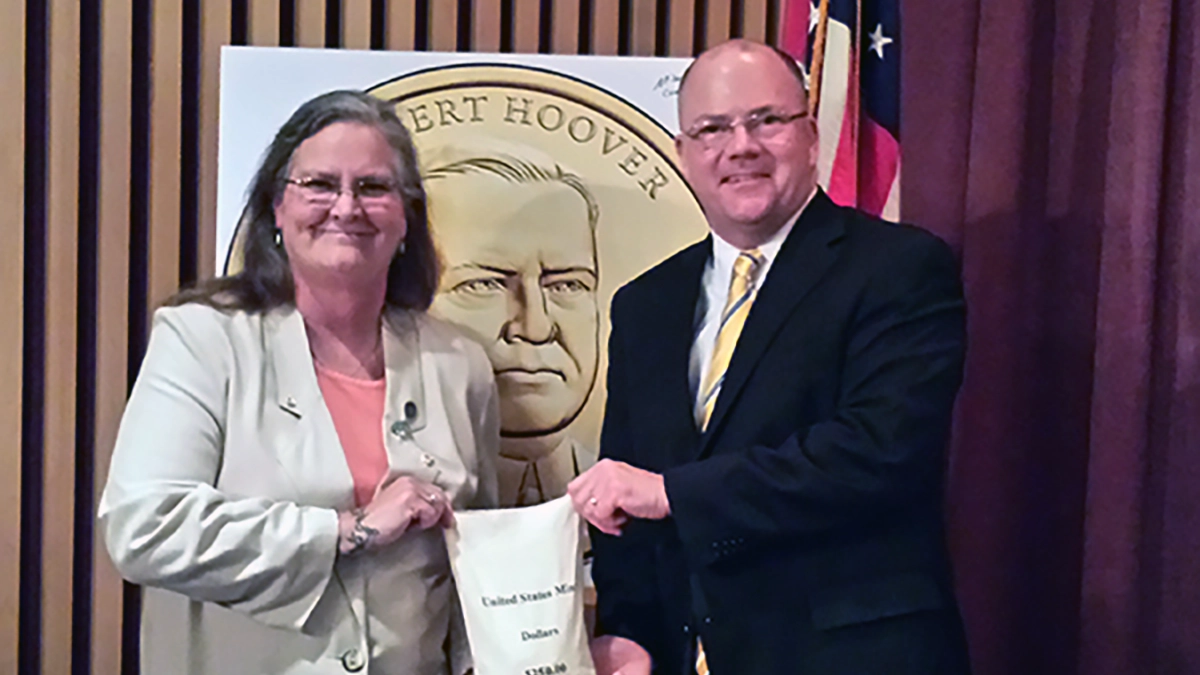
The first 100 children under 14 were presented with a free coin by Ms. Hoover-Lauble, and all attendees were able to purchase 25-coin rolls of 2014-P and 2014-D Herbert Hoover Presidential Dollars, as well as the four-coin 2014 Presidential Dollar Proof Set.
In conjunction with the launch ceremony, the Mint began selling P and D rolls, 100-coin bags, and 250-coin bags on the Mint’s web site and telephone ordering system.
* * *
2014-P Herbert Hoover Presidential Dollar Market Data and Noteworthy Specimens
Hoover Presidential Dollars typically trade raw and sell for about $3 each on eBay. $25 rolls sell for about $40 each.
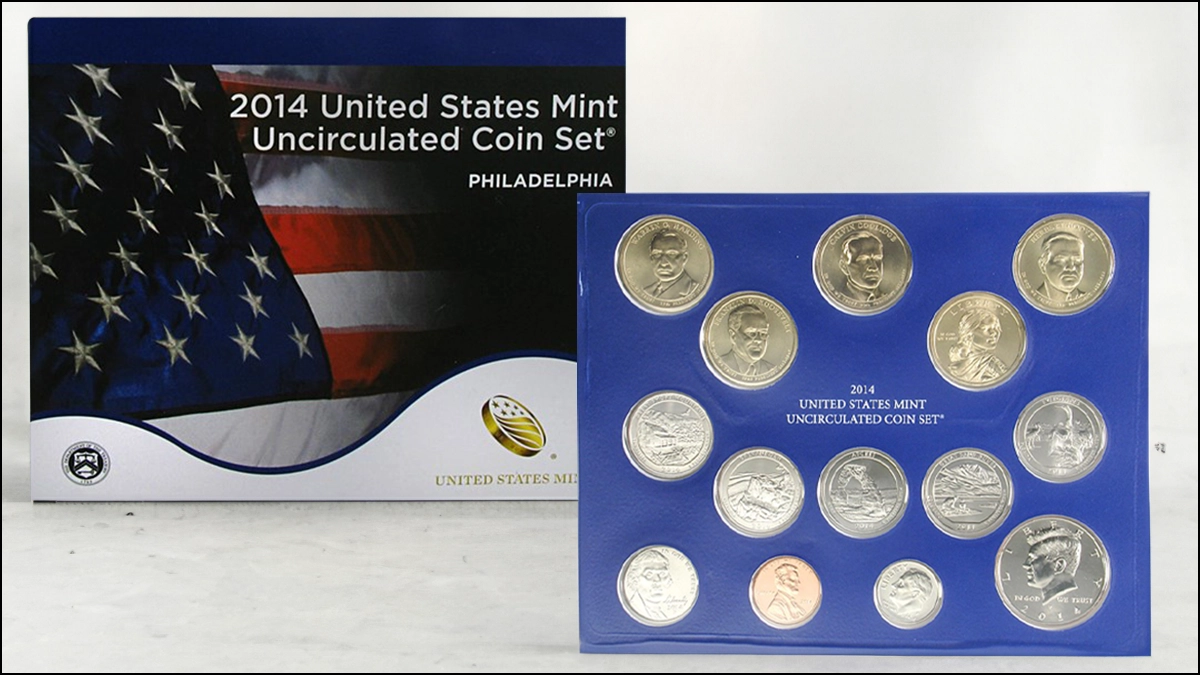
The 2014 United States Mint Uncirculated Coin Set is a great option for collectors interested in owning one of every business-strike coin issued in 2014. Containing $13.82 in face value coins from either Philadelphia or Denver, the set features all four 2014 Presidential Dollars, one 2014 Native American Dollar, and all five 2014 America the Beautiful Quarters, as well as examples of the Kennedy Half Dollar, Roosevelt Dime, Jefferson Nickel, and Lincoln Shield Cent.
A Word on Edge Lettering Position
Like a coin toss, Presidential Dollars entering the collar press for edge lettering did so randomly, without regard to which side of the coin was facing up or down. Consequently, the inscription is oriented differently depending on the outcome of this process. Some Presidential Dollars exhibit edge lettering that appears upside down when looking at the obverse; this is referred to as “Position A”. Coins with edge lettering that appears right-side up when looking at the obverse are labeled “Position B”. The relative rarity of either has yet to be determined by the hobby, but as Presidential Dollars are ultra-modern coin products, neither is likely “rare” in a real sense.
Still, some collectors find value in the distinction, and third-party grading services CAC and PCGS make note of the edge lettering position in their population data. However, we do not find it significant to the market at this time, so our top population reports below combine both Positions A and B.
Top Population: PCGS MS67 (76, 12/2024), NGC MS69 (1, 12/2024), and CAC N/A (0:0 stickered:graded, 12/2024).
- NGC MS68 #3912712-006: GreatCollections, May 20, 2018, Lot 581267 – View. Presidential Dollars label (#110, retired). Early Releases on insert.
- NGC MS68 #3914557-001: Heritage, January 31, 2017, Lot 30215 – $23. Presidential Dollars label (#110, retired).
- PCGS MS67 #30760580: GreatCollections, March 17, 2024, Lot 1188124 – View.
- PCGS MS67 #30154311: “The Erasmus Hall Registry Set of Presidential Dollars,” GreatCollections, August 14, 2022, Lot 1203318 – View. Portrait label.
- PCGS MS67 #30154312: GreatCollections, August 7, 2022, Lot 1196811 – View. Portrait label.
- PCGS MS67 #30360968: GreatCollections, May 22, 2022, Lot 1161120 – View. Portrait label.
- PCGS MS67 #30360991: GreatCollections, May 22, 2022, Lot 1161114 – View. Portrait label.
- PCGS MS67 #30813663: GreatCollections, October 27, 2019, Lot 747331 – View. Portrait label.
- PCGS MS67 #30154313: GreatCollections, September 29, 2019, Lot 747333 – View. Portrait label.
- PCGS MS66+ #84759606: GreatCollections, August 25, 2019, Lot 666920 – View. Weak Edge Lettering on insert.
- NGC MS66 #4852509-067: eBay, October 2, 2024 – $19.
* * *
Design
Obverse:
A more-or-less three-quarter profile of President Hoover faces right. Inscribed clockwise around the top of the design from the left is the name Herbert Hoover. Running counterclockwise from the left beneath Hoover’s effigy is the motto IN GOD WE TRUST followed by a space and the inscription 31st PRESIDENT 1929-1933. The initials PH of obverse designer, Mint Medallic Artist Phebe Hemphill, are in Hoover’s right suit collar near the truncation.
Reverse:
Don Everhart’s reverse design features an “ant’s-eye” view looking up at the Statue of Liberty, her extended elbow being the coin’s center point. The design is framed by a thin inner circle, which separates the graphic design from the legend UNITED STATES OF AMERICA. Beneath Liberty’s torch-bearing arm is the denomination $1. This is the common reverse design for all Presidential Dollar coins.
Edge:
The edge of the Presidential Dollar is lettered with the motto E PLURIBUS UNUM, the mintmark, the year of issuance, and 13 five-pointed stars. This edge inscription may be oriented facing the obverse (Position A) or the reverse (Position B).
Designers
Designer Phebe Hemphill joined the Mint in 2006, and since that time has become one of the nation’s most prolific coin designers (View Designer’s Profile).
Don Everhart joined the United States Mint in 2004 after a long and successful career as a sculptor and designer of medals. He retired in 2017 and now participates in the Mint’s Artistic Infusion Program (AIP) (View Designer’s Profile).
Coin Specifications
| Country: | United States of America |
| Year of Issue: | 2012 |
| Denomination: | One Dollar (USD) |
| Mintmark: | P (Philadelphia) |
| Mintage: | 4,480,000 |
| Alloy: | .770 Copper, .120 Zinc, 0.070 Manganese, 0.040 Nickel |
| Weight: | 8.10 g |
| Diameter: | 26.55 mm |
| Edge: | Lettered: * * * * * * * * * * 2014 P * * * E PLURIBUS UNUM |
| OBV Designer: | Phebe Hemphill |
| REV Designer: | Don Everhart |
| Quality: | Uncirculated |
* * *