


Morgan Beats Peace as 2026 Reverse Proof Silver Dollars Roar Back
Two famous American silver dollars returned on July 9, 2026. However, the United States Mint did more than change the date.
For the first time, collectors could buy the Reverse Proof Morgan Dollar and Reverse Proof Peace Dollar separately. The Mint also moved production from San Francisco to Philadelphia. Moreover, it added a dual date and a Liberty Bell privy mark for the nation’s 250th anniversary.
Collectors responded quickly.
During the first four days, the Mint recorded sales of 158,647 Morgan Dollars and 145,095 Peace Dollars. Combined sales reached 303,742 coins. That total marked a clear rebound for a modern series that had lost momentum during the previous two years.
Yet the numbers tell only part of the story. The 2026 release also created something the Morgan and Peace program had never offered before: a direct contest between two of America’s most celebrated silver dollar designs.
This time, collectors could vote with their wallets.
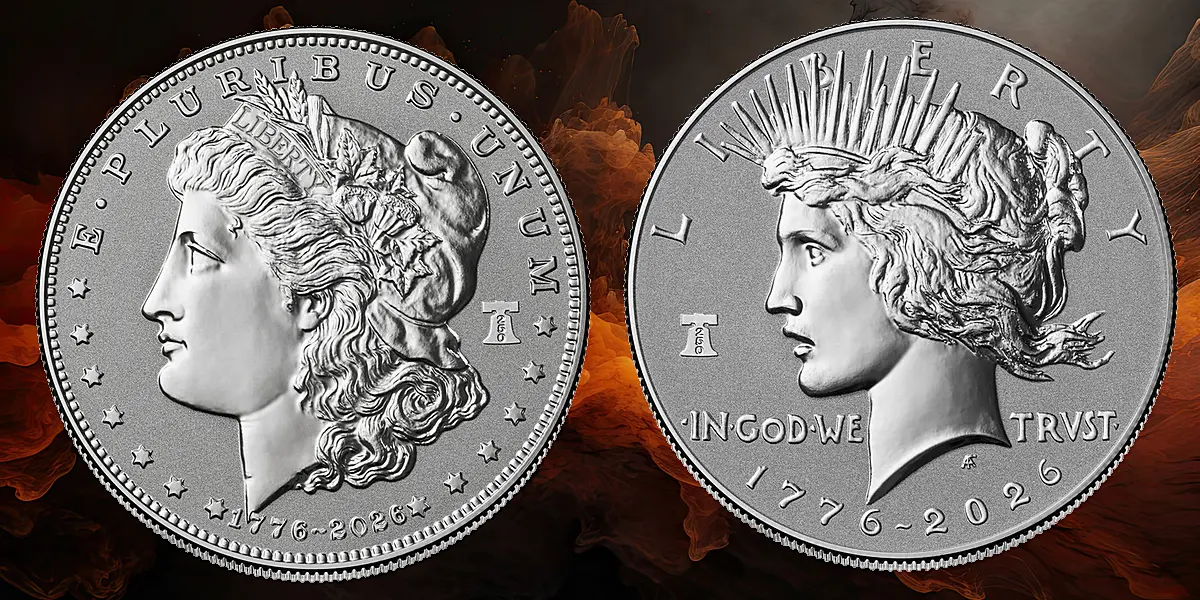
Two Silver Dollars From Two Different Americas
The Morgan and Peace Dollars share the same denomination. However, they tell very different stories about the United States.
George T. Morgan created the Morgan Dollar during an era of western expansion, silver politics, railroad growth, and industrial power. The Mint struck the original series from 1878 through 1904 and again in 1921.
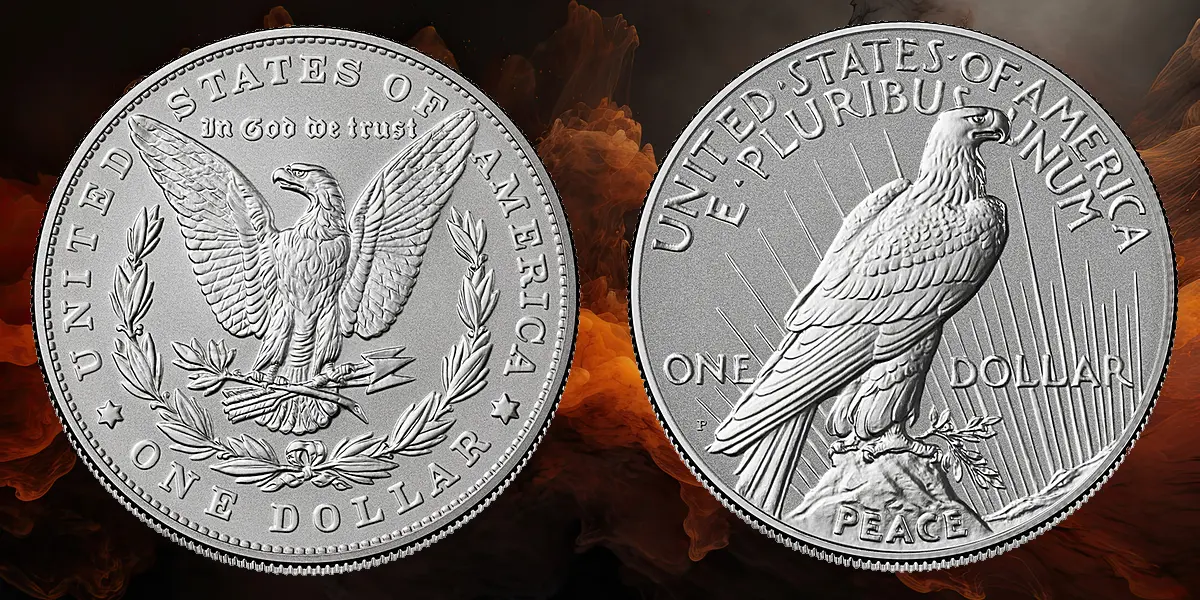
Its design reflects the confidence of the late 19th century. Liberty wears a cap, agricultural elements, and a crown bearing the word “LIBERTY.” On the reverse, an eagle holds arrows and an olive branch inside a wreath.
The Peace Dollar arrived in 1921 as the Morgan Dollar’s successor. Anthony de Francisci designed it after World War I. Instead of looking toward the frontier, the new dollar looked toward an uncertain peace.
De Francisci gave Liberty a radiant crown. On the reverse, an eagle rests on a mount while holding an olive branch. The word “PEACE” appears below.
The Mint struck the original Peace Dollar from 1921 through 1928 and again in 1934 and 1935. The design recognized the country’s wartime sacrifices while presenting the United States as an emerging international power.
Consequently, the two coins form a compact history lesson. The Morgan represents expansion and industry. The Peace Dollar represents sacrifice, victory, and hope.
That contrast gives the modern program much of its appeal.
America’s 250th Anniversary Changes Both Designs
The 2026 Reverse Proof coins add two one-year elements tied to the Semiquincentennial of American independence.
First, each coin carries a dual date of “1776 ~ 2026.” Second, each includes a Liberty Bell privy mark with the numeral “250.”
The Morgan Dollar Reverse Proof places the dual date around Liberty alongside 13 stars and the inscription “E PLURIBUS UNUM.” Its Liberty Bell privy mark appears on the reverse.
The Peace Dollar Reverse Proof carries the dual date beneath Liberty. Its familiar obverse inscriptions include “LIBERTY” and the traditional Peace Dollar spelling “IN GOD WE TRVST.” The reverse retains the resting eagle, olive branch, and bold “PEACE” inscription.
These additions do not replace the historic designs. Instead, they frame them within a much longer American timeline.
That choice works especially well for these two coins. The original Morgan and Peace Dollars already marked major chapters in national development. The 2026 issues now connect those chapters to the 250th anniversary of the Declaration of Independence.
Philadelphia Replaces San Francisco
The “P” mint mark may prove just as important to collectors as the anniversary privy.
From 2023 through 2025, the Mint struck the Reverse Proof Morgan and Peace Dollars at San Francisco. Each coin carried an “S” mint mark and appeared inside a mandatory two-coin set.
For 2026, the Mint transferred production to Philadelphia. Therefore, the new coins created distinct Philadelphia Reverse Proof issues rather than simple date extensions of the San Francisco run.
That change matters because many collectors organize modern collections by date, mint, finish, and privy mark. A 2026-P Reverse Proof does not fill the same space as a 2025-S Reverse Proof.
In other words, the Mint created several collection points at once:
The coins have a new date, a new mint mark, a one-year dual date, and a one-year Liberty Bell privy mark.
That combination gave established collectors several reasons to return.
Selling the Coins Separately Changed the Market
The format change may have had the greatest effect.
In 2023, 2024, and 2025, collectors had to buy the Reverse Proof Morgan and Peace Dollars together. That arrangement guaranteed equal distribution. However, it also forced Morgan specialists to buy a Peace Dollar and Peace Dollar specialists to buy a Morgan.
The 2026 release ended that requirement.
Each coin carried an issue price of $173. Therefore, a collector who wanted only one design could enter the program for less than the price of the 2025 two-coin set at launch.
However, a collector who wanted both 2026 coins had to spend $346.
The current comparison looks even more striking. The Mint later raised the price of the still-available 2025-S Reverse Proof set from its original $215 issue price to $375. As of July 27, the Mint lists both individual 2026 coins at $173 and the 2025 two-coin set at $375.
Thus, the new format lowered the commitment for a one-coin buyer. At the same time, it gave the Mint a higher combined price from collectors who purchased both.
Morgan Wins the First Direct Sales Contest
The separate format also produced a revealing result.
During the opening four-day period, collectors bought:
- 2026 Reverse Proof coin Opening sales Share of 250,000 limit
- Morgan Dollar 158,647 63.5%
- Peace Dollar 145,095 58.0%
- Combined 303,742
The Morgan Dollar outsold the Peace Dollar by 13,552 coins, or about 9.3%.
That margin does not represent a runaway victory. Nevertheless, it confirms the Morgan Dollar’s broader reach within the hobby.
Morgan Dollars support one of the largest and most active collecting markets in American numismatics. Collectors pursue them by date, mint mark, variety, prooflike designation, pedigree, and certified grade. Major registry-set competition also strengthens demand.
The Peace Dollar maintains a devoted following. However, its original series contains fewer dates, fewer major mint combinations, and a smaller overall collector ecosystem.
For the first time, the Mint’s sales format allowed that difference to appear clearly.
How 2026 Compares With Earlier Reverse Proof Releases
A direct comparison requires care because the earlier products contained two coins per set.
2023-S – Two-coin set cost $185. The Mint Sold 220,000 sets
2024-S – Two-coin set cost $215. The Mint Sold 149,346 sets
2025-S – Two-coin set cost $215. The Mint Sold 124,276 sets
2026-P Morgan – Individual coin cost $173. The Mint Sold 158,647 coins
2026-P Peace – Individual coin cost $173. The Mint Sold 145,095 coins
The 2023 release still holds the raw opening-volume record. Roughly 220,000 sets represented about 440,000 individual coins.
However, every buyer had to take both designs.
Demand then slowed. The 2024 set opened with 149,346 sales. The 2025 set fell again to 124,276. Those 2025 sets represented 248,552 individual coins.
Therefore, the 2026 opening of 303,742 individual coins exceeded the 2025 opening by 55,190 coins, or about 22%.
That rebound did not come from one change alone. Instead, several factors worked together. Individual sales reduced the entry price. Philadelphia created a new mint-mark variety. Finally, the dual date and Liberty Bell privy added a one-year anniversary identity.
The result broke the program’s two-year slide.
The 2023 High-Water Mark
The inaugural 2023-S Reverse Proof set entered the market with enormous momentum.
The Mint priced the set at $185 and capped production at 250,000. It became unavailable within roughly 24 hours. Mint sales later settled at 247,820 sets.
That release established the modern Reverse Proof Morgan and Peace pairing. It also showed how strongly collectors would respond to classic designs in a dramatic new finish.
Still, the secondary market produced mixed results.
Raw 2023 sets have generally traded around their original issue price rather than delivering spectacular gains. Certified coins in perfect Reverse Proof 70 holders often bring stronger premiums, especially with popular labels or release designations.
However, buyers should not treat a grading premium as guaranteed profit. Grading fees, shipping, dealer spreads, population growth, and label demand all affect the final result.
Moreover, a large percentage of modern Mint coins can earn top grades. As populations rise, premiums may narrow.
The lesson remains familiar: buy the coin first. Treat the holder, label, and possible resale premium as secondary considerations.
Early 2026 Secondary-Market Activity
The first 2026 shipments began reaching buyers in mid-July. Early asking prices for raw coins often appeared above the Mint’s $173 issue price.
Some listings clustered near $200 to $225 per coin. However, asking prices do not always equal completed sales. In addition, platform fees, postage, insurance, and returns can erase much of a seller’s apparent margin.
Early premiums often reflect impatience rather than long-term scarcity. Buyers may pay more to secure a coin before Mint shipments reach the wider market. Once supply spreads across dealers, auction platforms, and grading services, prices can change quickly.
The Mint also continued to offer both coins directly as of July 27. Therefore, collectors did not need to pay a secondary-market premium unless they wanted a specific certified grade, label, or delivery advantage.
Reverse Proof Finish Gives the Classics a New Personality
A Reverse Proof finish reverses the usual visual relationship of a standard Proof coin.
Traditional Proof coins normally show mirrored fields and frosted design elements. Reverse Proof coins use frosted fields and polished devices.
That contrast gives the Morgan and Peace Dollars a distinctly modern appearance. Liberty, the eagles, lettering, and anniversary elements rise with reflective brilliance against textured backgrounds.
The format also highlights differences between the designs.
Morgan’s dense wreath, lettering, hair detail, and feathered eagle create a busy play of light. By contrast, the Peace Dollar uses wider open spaces and simpler lines. Its resting eagle and radiant crown produce a calmer effect.
The finish does not merely decorate the designs. It changes how collectors read them.
Specifications for the 2026 Reverse Proof Dollars
- Denomination: $1
- Finish: Reverse Proof
- Composition: 99.9% silver
- Silver weight: 0.859 troy ounce
- Diameter: 1.500 inches, or 38.10 mm
- Edge: Reeded
- Mint and mint mark: Philadelphia, “P”
- Privy mark: Liberty Bell with “250”
- Mintage limit: 250,000 per coin
- Issue price: $173 per coin
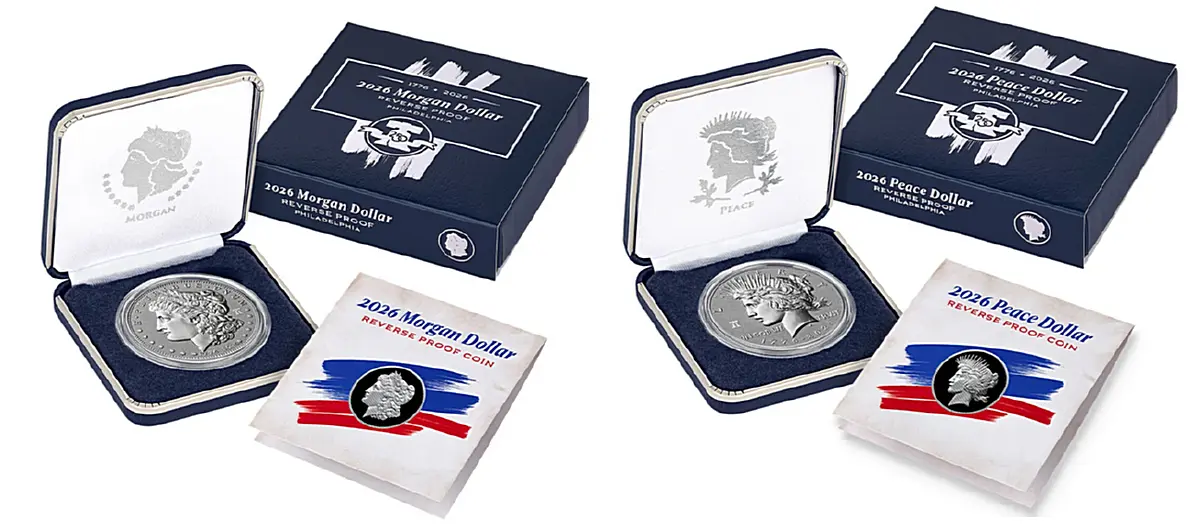
The Mint encapsulates each coin and places it inside a clamshell case and blue presentation box. Each product also includes a certificate of authenticity.
The Household Limit Changed After Launch
Collectors may encounter conflicting information about the household order limit.
Before the release, the Mint announced a limit of 10 coins per product option during the first 24 hours. The Mint later lifted that restriction. Consequently, the current product pages show no household order limit.
Both statements remain correct when attached to the proper date.
The opening restriction applied on July 9. The “none” listing reflects the current sales terms.
A Successful Reinvention of a Familiar Program
The modern Morgan and Peace Dollar program did not need another routine date change. After demand declined in 2024 and 2025, the Mint needed to give collectors a fresh reason to pay attention.
The 2026 release accomplished that goal.
It separated the coins. It moved them to Philadelphia. It added a dual date. It introduced a Liberty Bell privy. Most importantly, it connected two historic designs to the nation’s 250th anniversary without abandoning their original identities.
The sales results also revealed something collectors had long suspected. When buyers received a free choice, more selected Morgan.
Yet the Peace Dollar remained close enough to prove its lasting appeal.
These coins represent more than a rematch between two famous designs. Together, they trace the movement of the United States from continental expansion to global power. Now, the dates “1776 ~ 2026” place that story inside an even larger national frame.
That combination of history, symbolism, and collector choice turned the 2026 Reverse Proof Morgan and Peace Dollars into the strongest opening chapter the program has seen since 2023.





Two coins with a great history thanks for bring them back.
I wish we could find out just how much net profit the US Mint brings in each year. All the collector’s coins sell at ( on my opinion) a ridiculous premium.
To add a bit of backstory around the “traditional Peace Dollar spelling IN GOD WE TRVST”: While many people assume it’s an error or oversight that was never corrected, it’s actually an artistic affectation. During the early 20th century it was common for artists to use the Roman alphabet on classically-themed works. That alphabet had only 23 letters; the characters U, J, and W didn’t come into use until the 17th century or later. In fact the letter “V” served a _triple_ role
as a consonant, the modern vowel U, and the numeral 5. A Roman reader would have to decode its meaning based on context.*
It’s worth noting that Anthony de Francisci wasn’t the only numismatic artist of the period to use Roman lettering. Hermon A. MacNeil used the same U -> V substitution on his famed Standing Liberty Quarter (1916-30) which not only carried “TRVST” on its obverse but also E PLVRIBVS VNVM on the reverse.
[* The same held for the character I which could be a vowel, the consonant now represented by J, or the numeral 1. ]
Sweet coins!
Very informative article on the 1776-2026 Reverse Proof Morgan and Peace Dollars.
However, there does not appear to be a ’26 Proof coin of each either, so would it be fair to just show the total Morgan/Peace made for each year….proof, reverse proof and non-proof totals? I wonder why there is no ’26 proof, only reverse proof.