By CoinWeek …..
The Eisenhower Dollar debuted in 1971 with over 100 million copper-nickel clad coins struck for circulation and 11 million 40% silver versions struck for collectors and sold at a stiff premium. The 40% silver versions were split into two categories: Proofs and business strikes. The Proof versions were packaged in hardshell plastic cases, similar to those used for the GSA Morgan Dollars, and this case fit snug in a shell made of red flock, which fit into a slide-out cardboard box overlaid with a woodgrain print. Collectors called these “brown packs”.
In contrast, the 40% silver circulation strike Ike dollars were packaged in a thin plastic blister pouch (similar to the one used by the GSA for the non-Mint State Morgans), which came with a card that tried to explain away the shoddy condition of these supposed-premium coins.
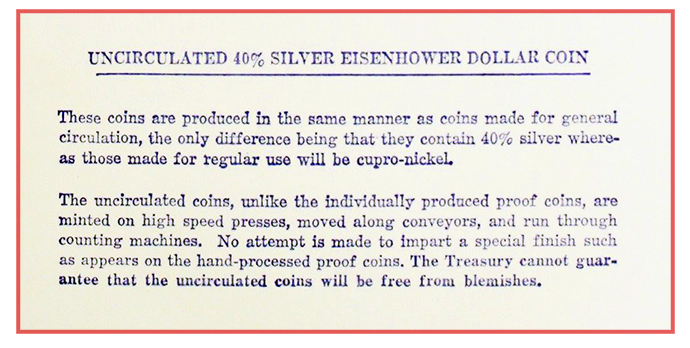
The Mint would get their act together in 1972, but collectors of the series have long known that the 1971-S business strike is the worst of the “Blue Packs”.
For years, Brown Pack and Blue Pack Ikes sold for a small premium over the coin’s silver content – a significant drop from their original sales price. This situation changed, however, when the third-party grading services began to certify modern coins and the condition census for Ike Dollars began to take shape.
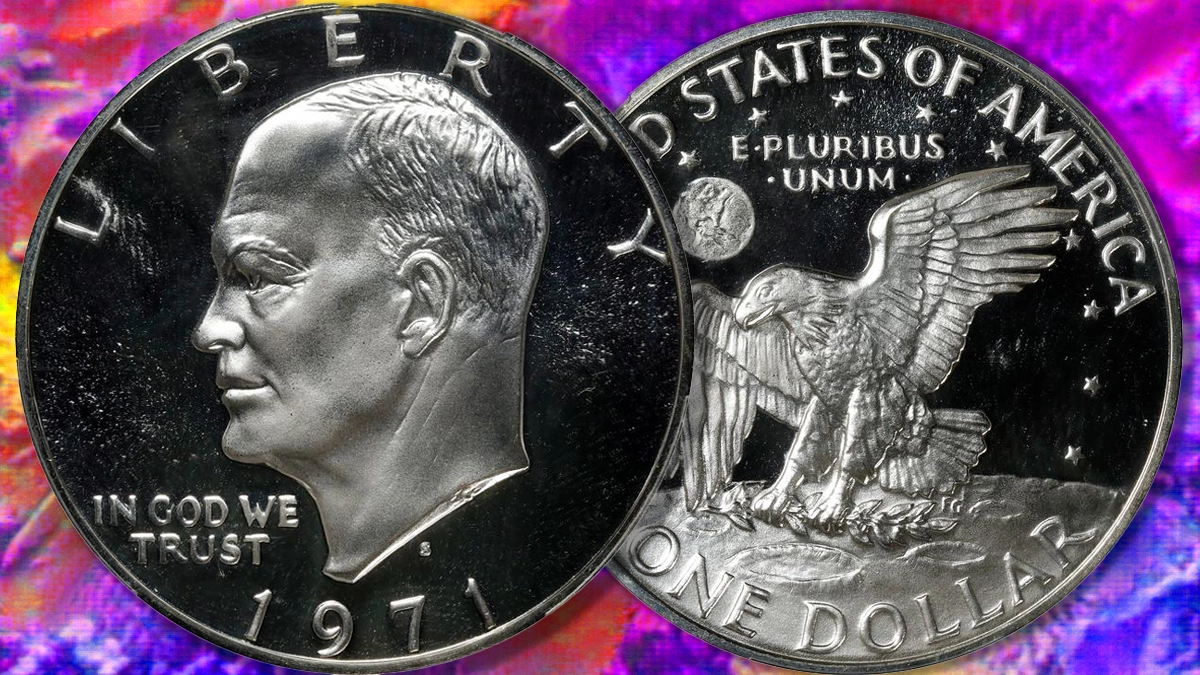
Toning or no toning, the typical 1971-S Eisenhower Dollar, like the coin imaged above, was struck with brilliant mirrors in the fields and frosted devices. This frosting often varies in thickness, which may frustrate the pickiest collectors. Still, the grading services have shown a high tolerance for this issue, and most Proofs will earn the Deep Cameo or Ultra Cameo designation.
Perhaps the most surprising aspect of Eisenhower Dollar Proofs is that the grading services seem to default grade an unimpaired Ike Proof as Proof 69. This does not hold for other coins from this era, and it is hard to fathom why a much larger coin would show fewer issues than the smaller Kennedy Half Dollar, Jefferson Nickel, or Roosevelt Dime.
Because of this, the certified market for Brilliant Eisenhower Dollar Proofs is limited to two grades, with Proof 69 being typical and Proof 70 being the exception. Recent market trends indicate that 69s sell for about $25 each, while 70s can sell for as much as $300 (a far cry from where these coins were 10 years ago).
Toned coins are treated differently. For these, the default grade seems to be Proof 68, with coins being either Cameo or Deep Cameo/Ultra Cameo. The toning pattern often obfuscates the contrast of the frost, making it difficult to determine how much is present.

These toned Proofs can often display vivid coloration, as evidenced by the monster toner (pictured above) that recently sold on eBay for $3,350 – a premium of over 130x the price of an untoned example. Dramatic toning like this typically occurs as the coin’s surface is exposed to environmental contaminants over time. The hard plastic shell that houses the coin is not airtight, and the flock material in the case is known to tone coins–especially the 1973 Proof.
Other dramatic 1971-S Ike Dollar toners have also been selling for big premiums on eBay lately. Their prices range from $550 to $800. The difference between these and the $3,350 coin is the PR68CAM grade (the others are graded PR67CAM) and the seller’s use of a PCGS TrueView photo to market the coin. This professionally produced image presents the coin accurately under ideal lighting conditions.
The other photos were amateurish and, in our opinion, leave too much to the imagination.
In a registry set, a monster toner in PR68CAM will not score as high as a brilliant coin in PR69DCAM – but that later coin is a dime a dozen. Monster toners have a proven track record of being a cut above.
* * *