By Charles Morgan and Hubert Walker for CoinWeek Notes …..
The Draped Bust Half Dime was last produced in 1805, the final year of a short five-year series of the type (no half dimes were produced in 1804). The production of half dimes (or picayunes) resumed in 1829, the first samples being struck early on July 4 as part of the cornerstone dedication ceremony for the second Philadelphia Mint building. The reason for the denomination’s resumption after two decades is unknown, but perhaps demand had grown for a denomination greater than one cent but less than a dime (Two-Cent Pieces, Three-Cent Silvers, Three-Cent Nickels, and Five-Cent Nickels would not be produced until the 1850s and ’60s). The new half dime was prepared by United States Mint Chief Engraver William Kneass, although many believe he adapted an earlier John Reich Capped Bust design.
Kneass’ effort was modified by Christian Gobrecht after Kneass became impaired due to physical issues. Gobrecht, who had prepared the letter and numeral punches for the Capped Bust coinage during Kneass’ tenure, was responsible for the subsequent Liberty Seated design. Capped Bust and Liberty Seated Half Dimes were both minted in 1837.
New Mint Technology Strikes Capped Bust Half Dimes
The Capped Bust Half Dime was produced using the close collar technology implemented by the Mint in the late 1820s. Earlier coins were edged prior to the obverse/reverse striking, but the close collar (essentially an edge die) eliminated this step, imparting the edge reeding as part of the striking process. The close collar also limited the outward spread of metal during striking, creating not only a uniform diameter to the finished coins but also stronger device impressions; metal constrained from flowing outward more completely flowed into the details of the design features. The close collar also produced a raised protective rim around the beads or denticles along the circumference, and enabled the minting of Proof coins with higher-quality details and polished surfaces.
How Much Are Capped Bust Half Dimes Worth?
Circulation-strike Capped Bust Half Dimes are relatively plentiful in census/population reports, though specific varieties are scarce or rare. A few Prooflike examples have been certified. Prices are modest up to near-Gem, becoming expensive as Gem or finer. The 1834 3 Over Inverted 3, 1836 3 Over Inverted 3, and 1837 Small 5C varieties have modest premiums over other dates, increasing by factors of two or more as Choice Uncirculated or finer.
Few Proof coins have been certified, including some with Cameo designations. All Proof examples are expensive even at lower grades, but more expensive as Select Proof or finer. There are minor price variations from year to year but no Proof issue is markedly more or less expensive than any of the other dates in the series.
In-Depth Date Analysis by CoinWeek Notes

Exclusive Coverage on CoinWeek
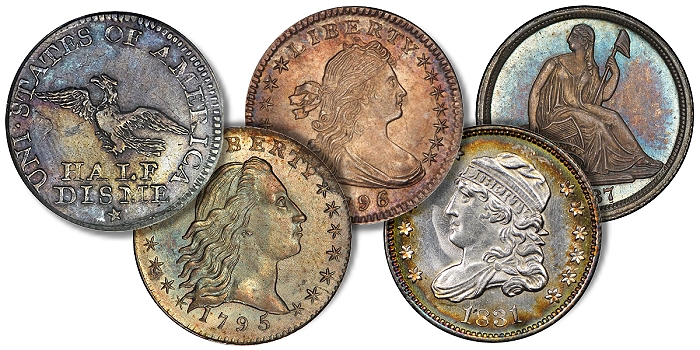
Writing for CoinWeek IQ, Lianna Spurrier presents a survey of the half dime as a denomination, from its origin as the half disme in 1792 to its replacement by the Shield Nickel in 1866.
Greg Reynolds on the Capped Bust Half Dime
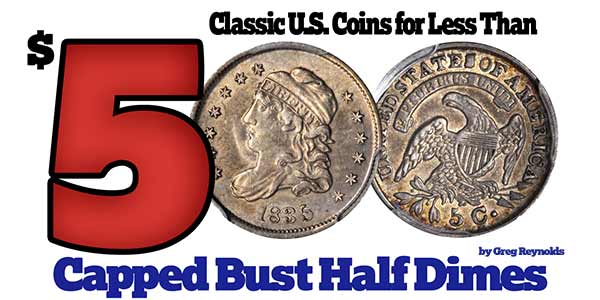
- Classic U.S. Coins for Less Than $500 Each, Part 27: Capped Bust Half Dimes
- Key Date Coins for Less Than $2,500, Pt. 2: Half Dimes
- The Marvelous Pogue Family Coin Collection, Part 2: The Oliver Jung 1833 Half Dime
U.S. coin expert and CoinWeek contributor Greg Reynolds offers in-depth analysis of the Capped Bust Half Dime as part of several of his long-running columns.
Design
Obverse:
Liberty faces left, wearing a softly folded mobcap (a woman’s headdress of the time) with the word LIBERTY around the base. Long curled hair extends from under the edge of the cap along the front and sides, cascading down Liberty’s neck and over her shoulder. Folded drapery wraps around the neck and down and across the bust, and is secured by a clasp above the shoulder. Thirteen six-pointed stars are arranged on both sides of Liberty, seven to the left and six to the right, all inside the beaded or denticulated border that is inside the raised smooth rim. The date is at the bottom.
Reverse:
The reverse displays a centered eagle, wings partially raised, clutching an olive branch in the sinister claw (viewer’s right) and three arrows in the dexter claw (viewer’s left). A shield is placed over the body of the eagle, and a concentric banner folded backward at the ends displays the motto E PLURIBUS UNUM above the eagle. The denomination 5 C. is at the bottom. The legend UNITED STATES OF AMERICA follows along the top three-fourths of the coin inside the beads or denticles that are placed next to a raised smooth rim. All coins were minted at Philadelphia and display no mintmark.
Varieties
Many varieties of the Capped Bust Half Dime are known, including the 1834 3 Over Inverted 3; the 1835 Large and Small Denomination and Large and Small Date; the 1836 3 Over Inverted 3; the 1836 and 1837 Large and Small Denomination; and other, more minor die variations. These varieties have been studied and cataloged by Russell J. Logan & John W. McCloskey.
Coin Specifications
| Capped Bust Half Dime | |
| Years of Issue: | 1829-37 |
| Mintage (Circulation): | High: 2,760,000 (1835); Low: 871,000 (1837) |
| Mintage (Proof): | High: 30 (1829, estimated); Low: 10 (1830-1833, 1835-1837, estimated) |
| Alloy: | .8924 silver and .1076 copper |
| Weight: | ±1.35 g |
| Diameter: | ±15.50 mm |
| Edge: | Reeded |
| OBV Designer: | William Kneass (possibly adapted from a John Reich design) |
| REV Designer: | William Kneass (possibly adapted from a John Reich design) |
* * *
Additional References
Bowers, Q. David. The Experts Guide to Collecting and Investing in Rare Coins. Whitman Publishing.
–. A Guide Book of United States Type Coins. Whitman Publishing.
Breen, Walter. Walter Breen’s Encyclopedia of U.S. Coins. Doubleday.
Guth, Ron, and Jeff Garrett. United States Coinage: A Study by Type. Whitman Publishing.
Logan, Russell J. and John W. McCloskey. Federal Half Dimes. John Reich Collectors Society.
Taxay, Don. The U.S. Mint and Coinage. Arco Publishing.
Yeoman, R.S., and Jeff Garrett (editor). The Official Red Book: A Guide Book of United States Coins. Whitman Publishing.
* * *